A Centralised Industry Collaboration Function for ICT Higher Education

Anyone near a university's industry office knows the pattern. A partner phones a lecturer they happen to know. A capstone project gets "sponsored" with a handshake. A handful of students land brilliant internships while others never get a foot in the door. Nobody is quite sure who signed what, who owns the code, or where the client's data went at the end of the semester.
That pattern is the starting point for a paper I co-authored with Prof Japie Greeff and Prof HB Klopper: Designing a Centralised Industry Collaboration Function for ICT Higher Education: A Governance-Oriented Framework for Employability, Mentorship, and Innovation. This post walks through the thinking behind it, the framework itself and the early evidence from applying it.
Why ad hoc collaboration is no longer enough
The WEF Global Risks Report 2026 places higher education squarely inside technological acceleration and systemic risk. Technology creates opportunity in education, health, agriculture and infrastructure, while also introducing risks for labour markets, information integrity, cybersecurity and long-term AI governance. More than 1,300 experts in the WEF Global Risks Perception Survey flag technology as both an opportunity and a systemic risk.
Labour markets are being reshaped by technological change, demographic shifts, economic uncertainty and geoeconomic fragmentation, and they are moving faster than curricula. Graduates now need to show more than disciplinary knowledge. They need to translate that knowledge into workplace capability, with adaptive judgement, digital resilience, ethical awareness and responsible technology practice.
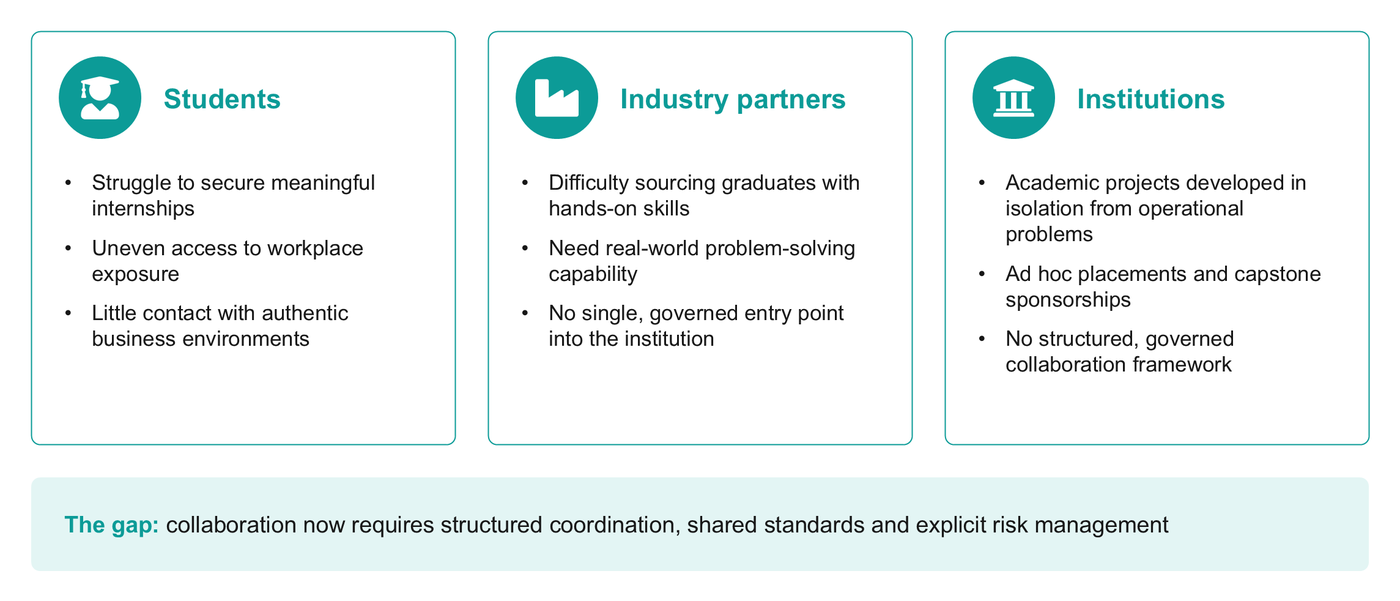
Fragmented collaboration leaves everyone short.
When collaboration stays fragmented, everyone loses something:
- Students struggle to secure meaningful internships, have uneven access to workplace exposure and little contact with authentic business environments.
- Industry partners find it difficult to source graduates with hands-on skills and have no single, governed entry point into the institution.
- Institutions end up with academic projects developed in isolation from operational problems, plus ad hoc placements and capstone sponsorships with no structured framework around them.
The gap is clear: collaboration now needs structured coordination, shared standards and explicit risk management. That matters most where student projects touch proprietary business problems, intellectual property, personal information, code repositories, AI tools and cross-border data flows.
The research question
The paper asks one question: how can a higher education institution design a centralised function that simultaneously advances graduate employability, structured mentorship, governance and innovation commercialisation?
It makes two contributions. First, it turns an institutional concept proposal into a publishable conceptual framework for ICT higher education institutions. Second, it treats employability, innovation, governance and commercialisation as one institutional design problem rather than four separate administrative streams. The scope is deliberately narrow for now: the originating South African institution and the ICT industry.
Three literatures, one missing architecture
The framework draws on three strands of literature that are usually treated separately:
- Triple Helix (Etzkowitz and Leydesdorff; Hailu). University–industry–government interaction creates an innovation "overlay", and universities become active innovation role-players. In this view the central function is an intermediary, not an admin office.
- Academic engagement (Perkmann et al.; Berg). Engagement is broader than commercialisation: collaborative and contract research, consulting and informal ties are more widely practised than formal commercialisation. Engagement and co-creation come first; commercialisation sits downstream.
- Governance and POPIA. South Africa's Protection of Personal Information Act 4 of 2013 brings accountability, openness, security safeguards and data subject participation, along with limits on cross-border transfers and solely automated decisions. For industry-linked ICT student projects, breach notification, information officer responsibilities and transparency duties become central design requirements rather than peripheral compliance matters.
The research gap is that nobody had linked these into a single institutional architecture.
Built with Design Science Research
The study uses Design Science Research (DSR), following Hevner et al. DSR suits this problem because we were not only trying to understand it; we were designing a purposeful artefact to address it. It had to be relevant (fragmented collaboration and uneven internship access are real needs), rigorous (grounded in literature, institutional knowledge and established methods) and a concrete artefact: an operating model, lifecycle, governance areas, responsibilities, IP strategy and indicators.
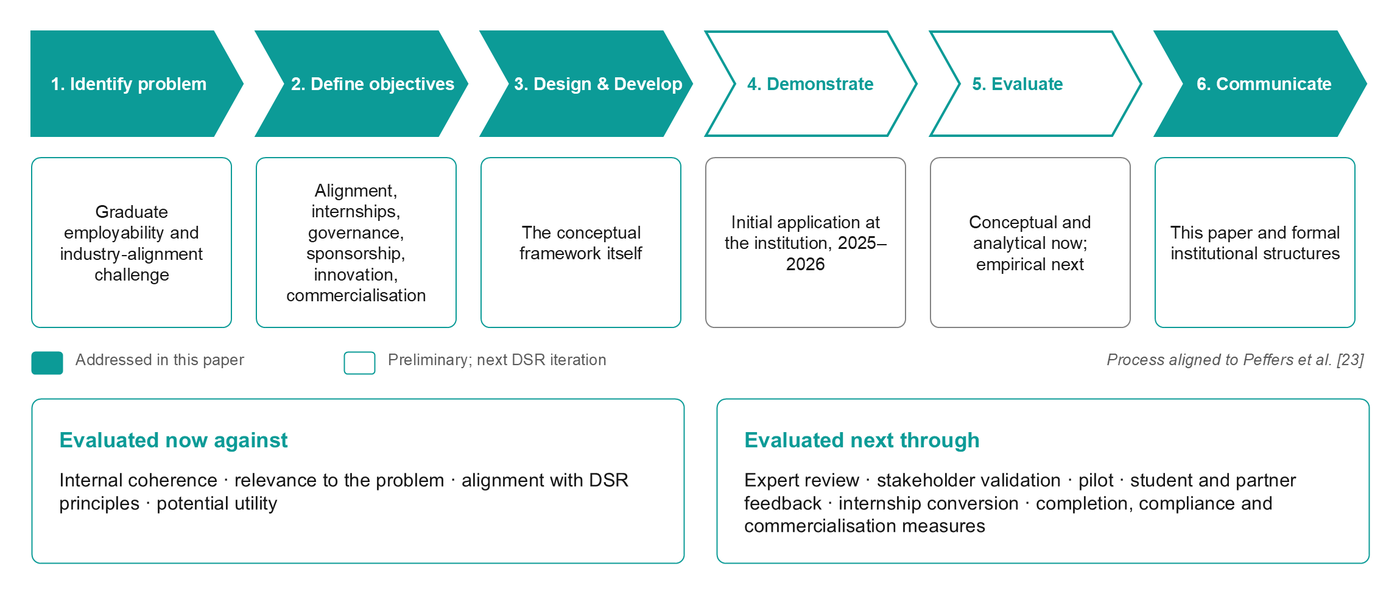
An ex-ante design, following the DSR process of Peffers et al.
It is an ex-ante design: built conceptually before full implementation. The process follows Peffers et al.: identify the problem, define objectives, design and develop, demonstrate, evaluate and communicate. Right now the framework is evaluated on internal coherence, relevance to the problem, alignment with DSR principles and potential utility. The next iteration adds expert review, stakeholder validation, a pilot, student and partner feedback, and measures such as internship conversion, completion, compliance and commercialisation. I want to be upfront about that: this is a conceptual and institutional contribution, not a fully tested intervention.
The CCBF: one function, six keys
The framework centres on a Centralised Consulting Business Function (CCBF), a strategic intermediary that:
- onboards partners and mentors through formal MOUs;
- sources live industry problem statements;
- maps projects to student competencies and curriculum outcomes;
- coordinates mentorship with industry professionals;
- oversees ICT operations, ethics, data and responsible AI use; and
- manages IP and commercialisation pathways.
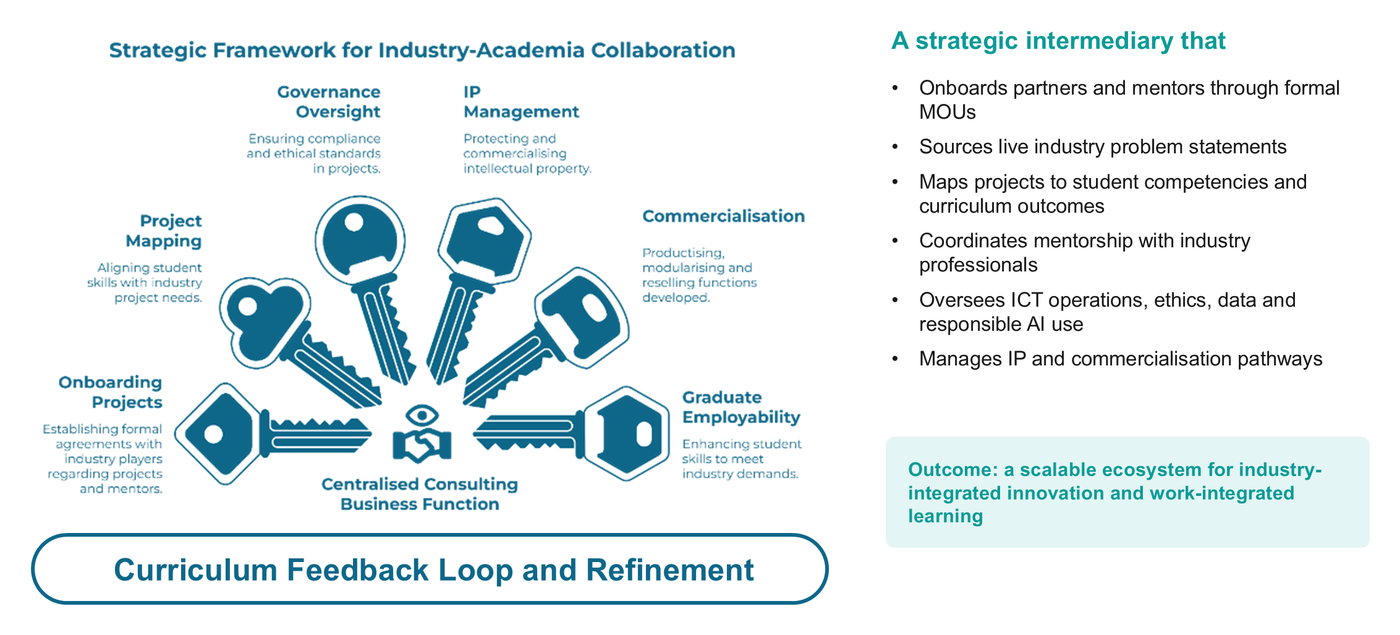
Onboarding, project mapping, governance oversight, IP management, commercialisation and graduate employability, held together by a curriculum feedback loop.
Five strategic objectives drive it: industry alignment, internship enablement, applied innovation, knowledge sponsorship and innovation commercialisation. Knowledge sponsorship deserves a special mention. Partners can contribute far more than money: mentorship, expertise and best practice, operational insight, access to problem statements, systems and datasets, and governance guidance. Both financial and non-financial contributions count, which lowers the barrier for organisations to take part.
Every interface becomes a governed agreement
This is the part I find most practical. On the internal side, the CCBF team includes the Dean of Research and Postgraduate Studies, an Industry Coordinator, an Internationalisation Officer, a Community Engagement Officer, the Academic Head and an IP Officer (Legal). On the external side, industry stakeholders are classified in a taxonomy: knowledge areas (Hardware, Software, Auxiliary and Vendors) crossed with stakeholder levels (Decision Makers, Leaders and Professionals), across national and international markets.
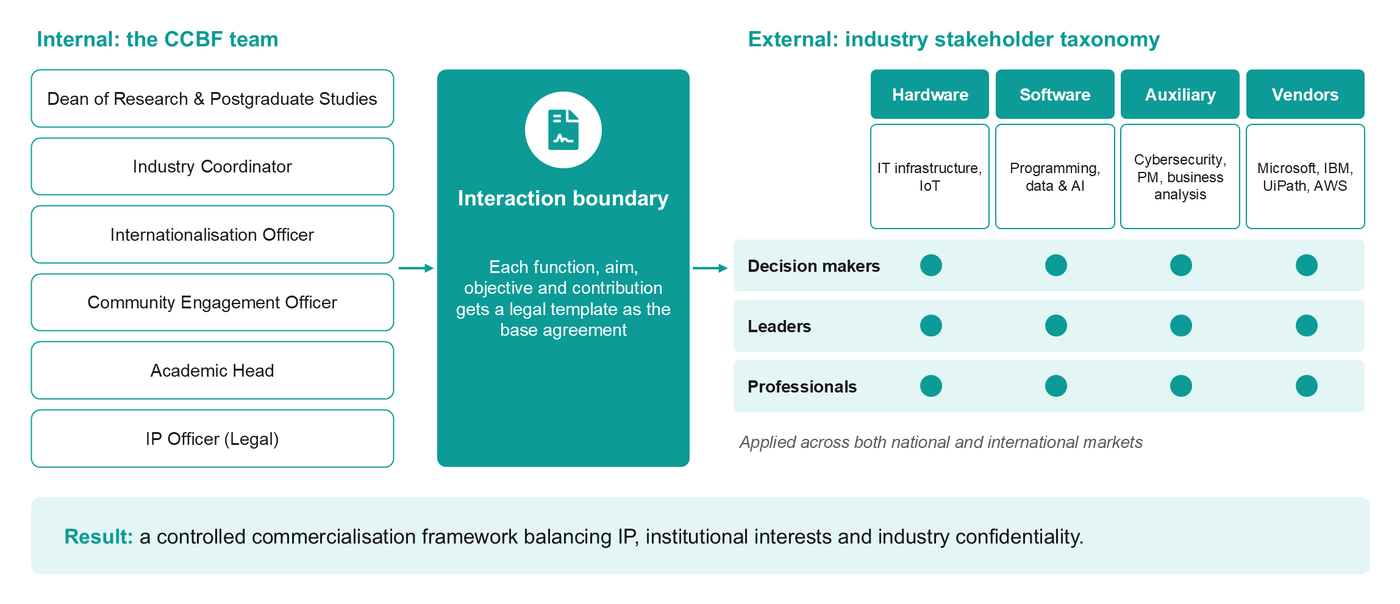
Each function, aim, objective and contribution gets a legal template as its base agreement.
The result: a controlled commercialisation framework balancing IP, institutional interests and industry confidentiality.
Early evidence from 2025–2026
During the initial application over 2025 and into 2026:
- 105 industry advisors and partners were classified in the taxonomy;
- they represent 32 organisations;
- 67 organisations took graduates into internship and junior developer roles; and
- 203 LinkedIn profiles of 2025 alumni were analysed.
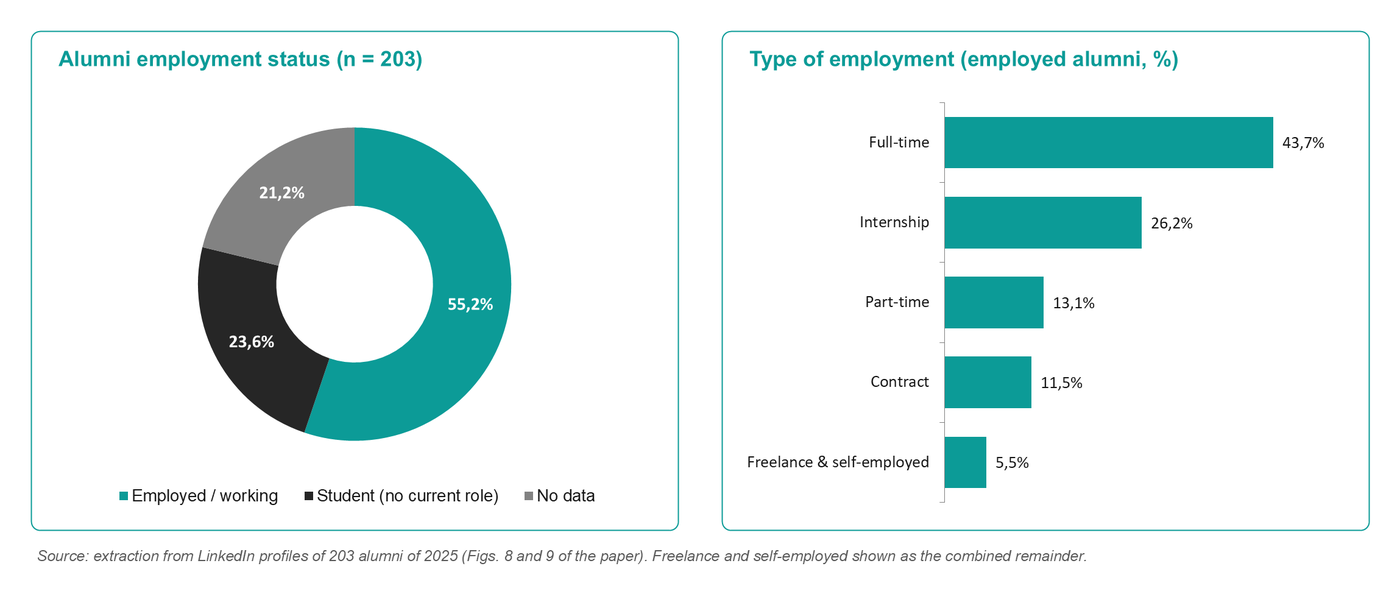
Source: extraction from LinkedIn profiles of 203 alumni of 2025 (Figs. 8 and 9 of the paper).
Of the 203 alumni, 112 (55.2%) are currently employed, across 67 unique employers. A further 23.6% indicate they are still students, either continuing to postgraduate study or with profiles not yet updated, and there was no information for 21.2%. Among employed alumni, the main types are full-time (43.7%) and internships (26.2%).
The earlier ad hoc approach did still place students, but not in a controlled and measured way. Employability, the main aim, is simply the first thing we evaluated.
Lessons learned
The biggest lesson is that alumni are the institution's ambassadors, and the data is not yet complete. Not all alumni have LinkedIn accounts or keep them up to date, so qualification, certification, skill and employer breakdowns are still partial. Teaching students to manage their online presence well shows them what employers look at, and it lets the institution track outcomes. Online-presence training is therefore going into the CCBF portfolio.
Next comes expert review, stakeholder validation, a full pilot and measurement of every interface. The longer-term vision is for the CCBF to carry lessons from exit-level students all the way back to entry-level students, and to become the embedded function driving decisions on qualifications, curriculum, extracurricular activities and industry partnerships.
Key takeaways
- Internships, projects, mentorship, IP management and compliance should not be managed as isolated activities.
- A meso-level intermediary like the CCBF translates live industry demand into governed student participation.
- If your students touch real client data, governance (and in South Africa, POPIA) is a design requirement, not an afterthought.
If you are in higher education and wrestling with the same "who signed what?" problem, I would love to compare notes. Bridging the gap works much better when we do it together.