From Side Hustle to Main Gig: Turning an Idea Into a Running Business With AI
Building the thing stopped being the hard part.
Today, AI can write the website, design the collateral, draft the copy, make the diagrams and set up the tracking. In my From Side Hustle to Main Gig session (a practical demonstration and hands-on lab), I built a real business website live, from nothing, to prove it.
The full hands-on lab is free on GitHub, so you can work through it at your own pace: https://jacquim.github.io/Side-Hustle-to-Main-Gig/. It covers 18 modules plus business setup for 15 African countries.
But AI did not decide what to sell, who to serve or what is true, and it doesn't carry the responsibility. Everyone in your market has the same tools now, so execution stops being the advantage. Judgement, trust and specific knowledge start being it.
Six steps, and they go in this order
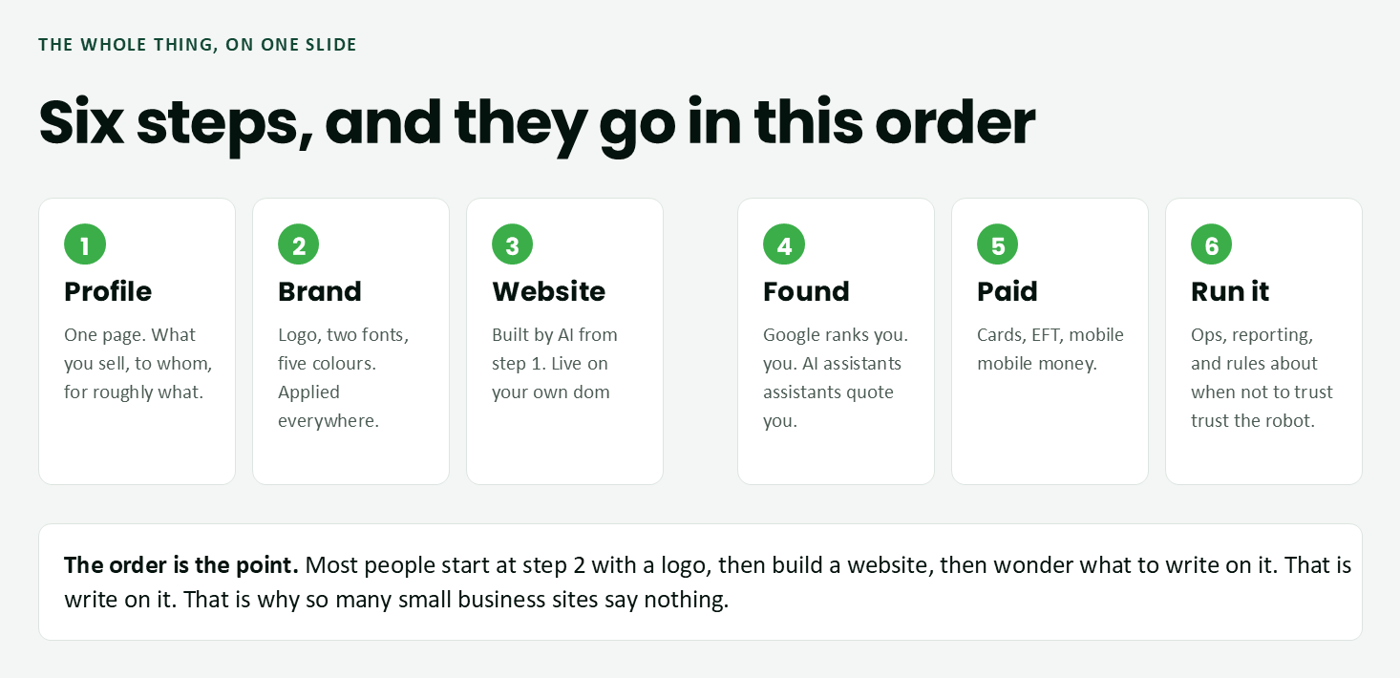
The order is the point.
- Profile: one page. What you sell, to whom, for roughly what.
- Brand: a logo, two fonts and five colours, applied everywhere.
- Website: built by AI from step 1 and live on your own domain.
- Found: Google ranks you and AI assistants quote you.
- Paid: cards, EFT, mobile money.
- Run it: ops, reporting, and rules about when not to trust the robot.
Most people start at step 2 with a logo, then build a website, then wonder what to write on it. That's why so many small business sites say nothing.
Before anyone asks: what it costs
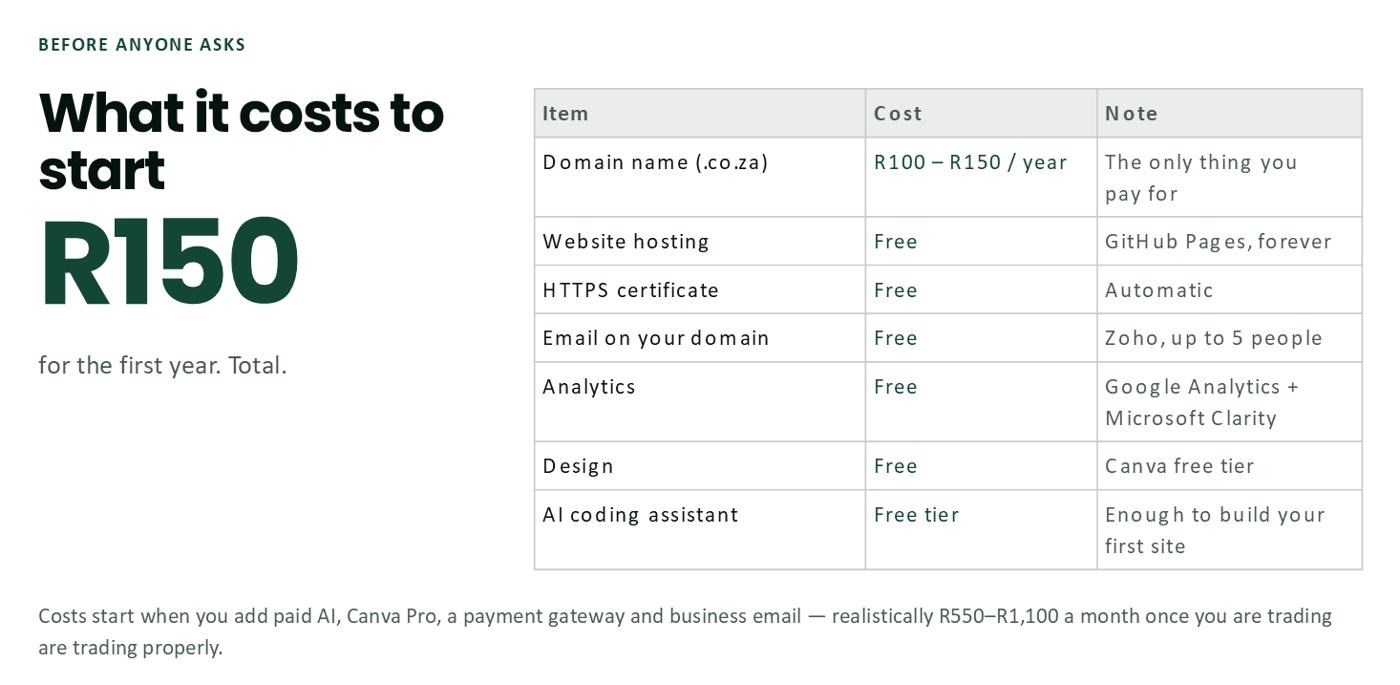
The only thing you must pay for is the domain name.
R150 for the first year. Total. A .co.za domain costs about R100–R150 a year. Hosting (GitHub Pages), the HTTPS certificate, email on your domain (Zoho, for up to 5 people), analytics (Google Analytics and Microsoft Clarity), design (Canva's free tier) and an AI coding assistant's free tier are all free.
Costs only start when you add paid AI, Canva Pro, a payment gateway and business email. Realistically that's R550–R1,100 a month once you're trading properly, and all of it is optional at the start.
Step 1: Write one page, not fourteen
The one-pager is the source document for everything else. Your website, bios and AI prompt all come from it.
A 14-page company profile belongs to the tender world. The one-pager is what you'll send constantly, to prospects deciding whether to reply.
What goes on it: what you do, who you help, the problem, what people can buy (with prices), why you, one piece of proof, your registration numbers and one next step.
The rules: under 400 words. Readable in WhatsApp. A price range on it ("From R2,500" saves you a phone call and filters out people who were never going to buy). One call to action. No mission statement. Nobody has ever bought anything because of a mission statement.
Step 2: Brand, or "can someone tell it's you without reading the name?"
That's the entire test. At this scale, brand isn't an identity system. It's five decisions applied consistently: 1 logo (plus 3 variants), 5 colours (contrast-checked), 2 fonts (two, not five), 1 photo style (real photos) and 3 adjectives for how you sound.
And because everyone has the same AI tools, polish has stopped signalling competence. It signals anyone. What signals competence now is evidence. Use AI for the scaffolding; keep the human parts human: photos of your actual work, your face and voice, replies to messages, and every single testimonial. A slightly blurry photo of you on site beats a perfect AI render, because it's evidence you exist. And fake testimonials aren't just embarrassing. They're prohibited under the Consumer Protection Act.
Step 3: The website (pick the boring one)
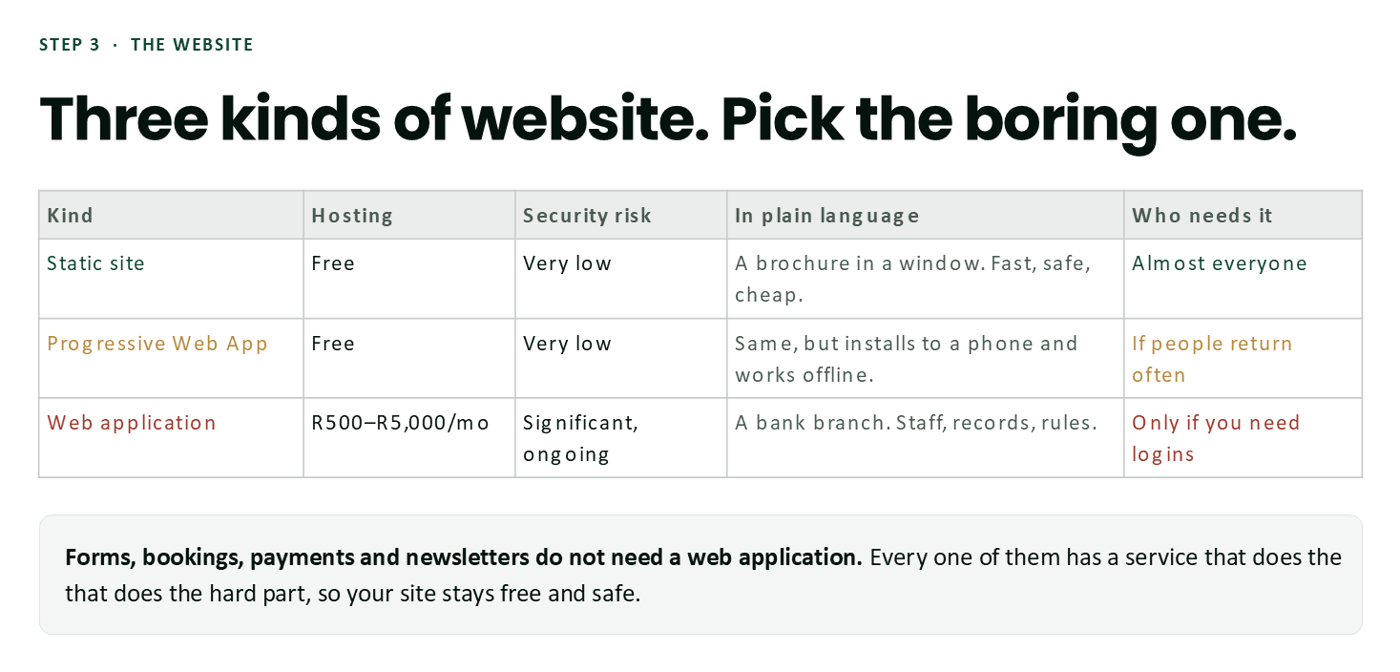
A static site is a brochure in a window. A web application is a bank branch.
Almost everyone needs a static site: it's free, fast and very low risk. A progressive web app also installs on a phone and works offline. A web application (R500–R5,000 a month, with significant ongoing security risk) is only for when you genuinely need logins. Forms, bookings, payments and newsletters do not need a web application. Every one of them has a service that does the hard part for you.
You don't write code. You write a brief. Mine covers the technology, pages, brand and contact details. Then comes the important half: do not invent testimonials, clients or statistics. Do not put any key or password in the code. Do not use lorem ipsum. List every placeholder I still have to fill in. List every fact you were unsure about. That last instruction turns a black box into something you can actually check.
In the live build, I didn't write any code or pay anyone. What still needed me: checking every price, checking every claim, clicking every link and owning what it says.
Step 4: Know what's happening, and get found
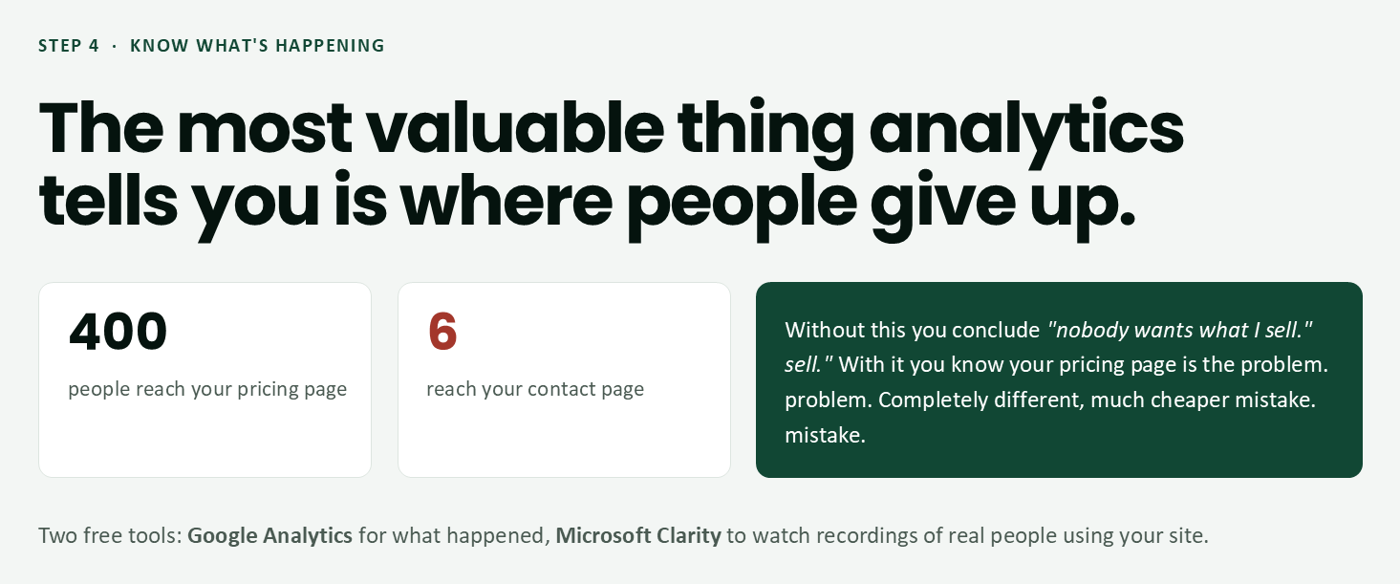
The most valuable thing analytics tells you is where people give up.
Without analytics you conclude nobody wants what you sell. With it, you learn your pricing page is the problem: a much cheaper mistake. Use Google Analytics for what happened and Microsoft Clarity to watch recordings of real people using your site. Track the WhatsApp button click as a conversion. That's the number that means money.
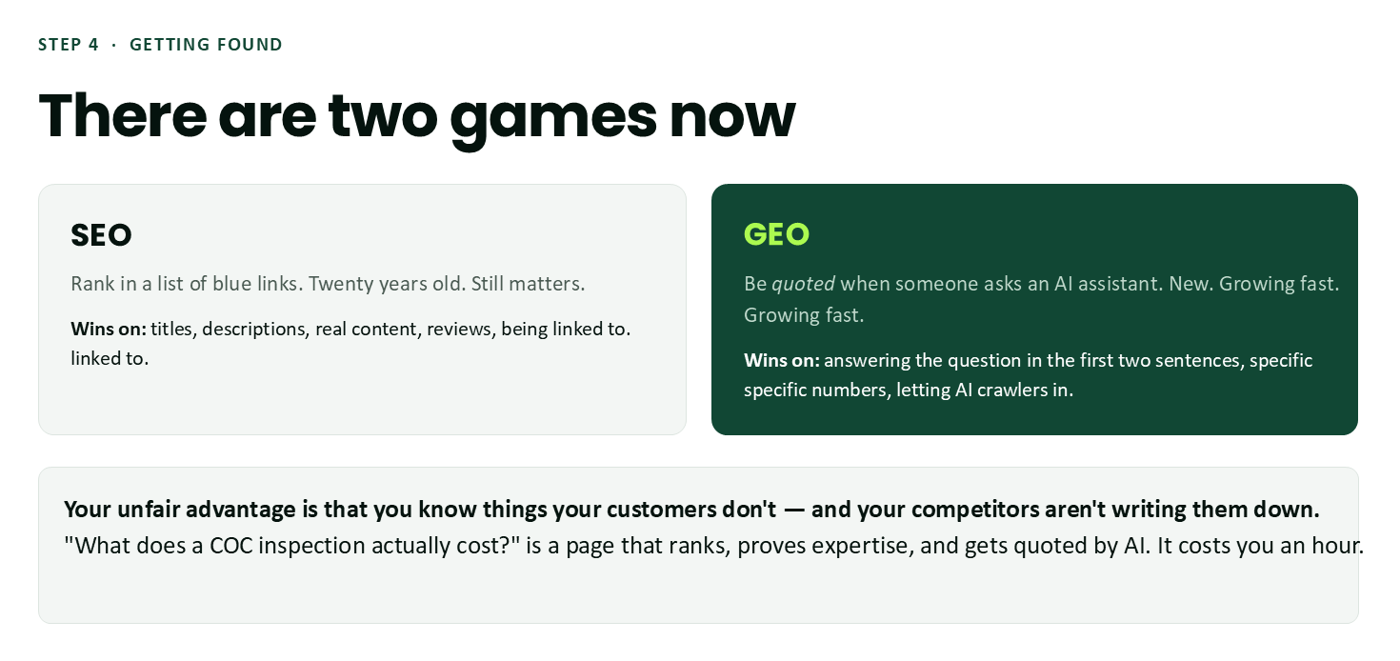
There are two games now.
SEO is ranking in the list of blue links, and it still matters. GEO (generative engine optimisation) is being quoted when someone asks an AI assistant. Your advantage is what you know that your competitors aren't writing down. A page answering a question your customers always ask ranks well, proves your expertise and gets quoted by AI. Two quick, free wins: claim your Google Business Profile and list yourself on Bing Places.
Step 5: Get paid the way your customers already pay
Manual EFT is free and still normal for B2B. Instant EFT costs about 1.5%. Cards cost about 2.6–3.5%. Mobile money varies by market, and in much of Africa wallets outnumber cards. Payment links cost the same as cards and don't need a website at all, so you can send one today.
Two rules: never put card fields on your own site (the customer pays on the provider's page and comes back), and negotiate. At R50,000 a month, 3.5% is R21,000 a year. Almost nobody phones to ask for a better rate.
Step 6: Run it, and know where it goes wrong
Everything on your website is public. Press F12 in any browser and read it. If you paste an API key into your site, bots will find it, often in under five minutes. If you wouldn't print it on a billboard, it can't go on your website.
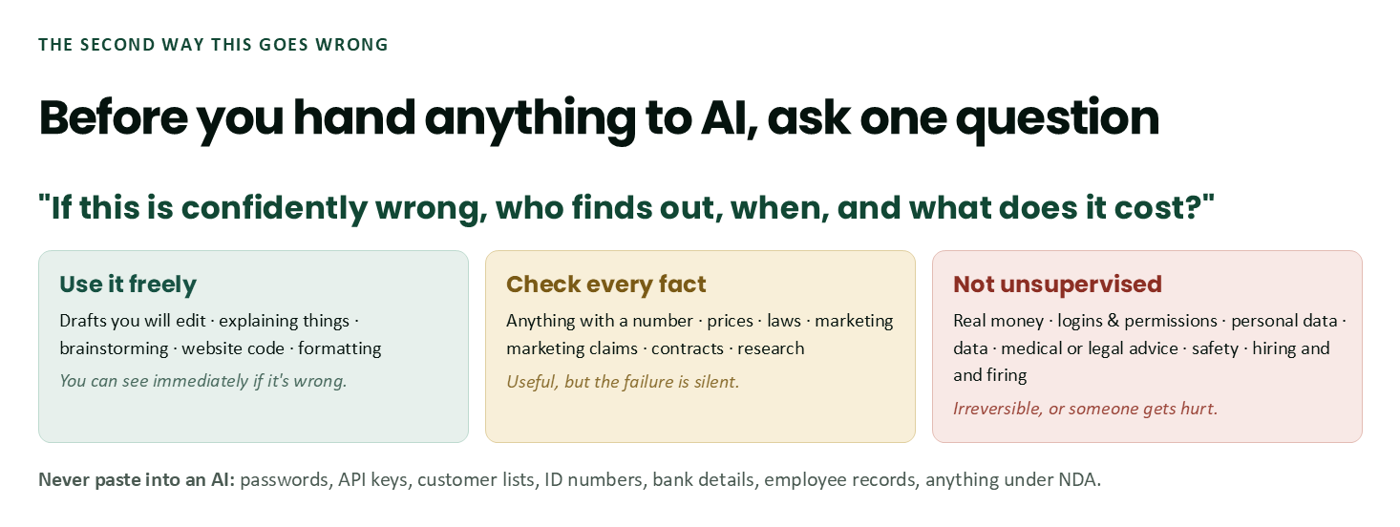
"If this is confidently wrong, who finds out, when, and what does it cost?"
Use AI freely for drafts, explanations, brainstorming and website code, because you'll see straight away if it's wrong. Check every fact when there's a number, price, law, claim or contract involved. And don't let it run unsupervised with real money, logins, personal data, medical or legal advice, or hiring and firing.
Three things. This week.
- Write the one page. Under 400 words. Everything else comes from it.
- Claim your Google Business Profile. It takes thirty minutes and it's free. For a local business it beats your website for the first three months.
- Ask one customer for a review. Real proof beats anything AI can generate.
Not one of these needs a developer, a budget or permission. And notice that none of them is "build a website". That's the easy part now.
When you're ready for the rest, the step-by-step lab is waiting: https://jacquim.github.io/Side-Hustle-to-Main-Gig/