AI for Africa, by Africa: Inclusion, Diversity and Innovation
Does your phone's voice assistant understand isiZulu, Setswana, Bemba or Yoruba?
That is the question I opened with at TICON Africa 2026 in Livingstone, Zambia, and it is a good one to sit with for a moment. Today's conversation is about who AI is built for, and who builds it. My talk, AI for Africa, by Africa, was about inclusion, diversity and innovation: building AI on our own foundations.
Ubuntu: a person is a person through other people
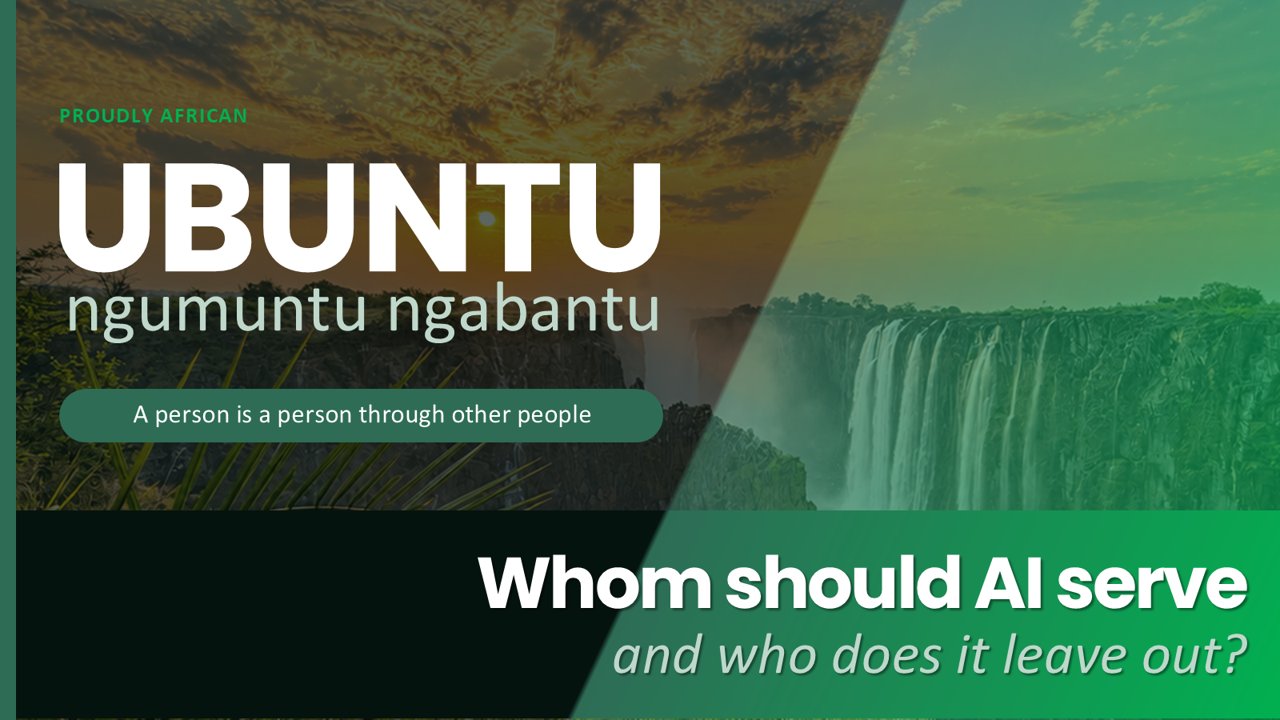
Umuntu ngumuntu ngabantu. A person is a person through other people. Ubuntu is a very African way of looking at the world, and it gives us the best question to ask of any technology: whom should AI serve, and who does it leave out?
Ikigai and Ubuntu: two ways to rise
To explain why that question matters, I set Ubuntu next to an idea many people already know: Ikigai.
Ubuntu comes from the Nguni saying Umuntu ngumuntu ngabantu, "a person is a person because of another person". Our identity and humanity are formed through relationships, belonging and how we treat others. It starts with the community and reaches in.
Ikigai is the Japanese idea of a "reason for being": the everyday purposes that make life worth living. It starts with the self and reaches out. (The popular four-circle Venn diagram you've probably seen is a Western adaptation, not the original Japanese idea.)
Put side by side, they ask different questions:
| Ikigai asks | Ubuntu asks | |
|---|---|---|
| Of a person | Why do I rise? | Who do I rise for? |
| Of AI | What purpose should AI serve? | Whom should AI serve, and who does it leave out? |
They aren't opposites. Japanese culture is deeply communal too, and Ubuntu doesn't erase the individual. The difference is the starting point. AI built for Africa needs both, and Ubuntu's question is the one the world keeps forgetting to ask.
Look around a room like the one at TICON Africa and the answer starts to take shape.
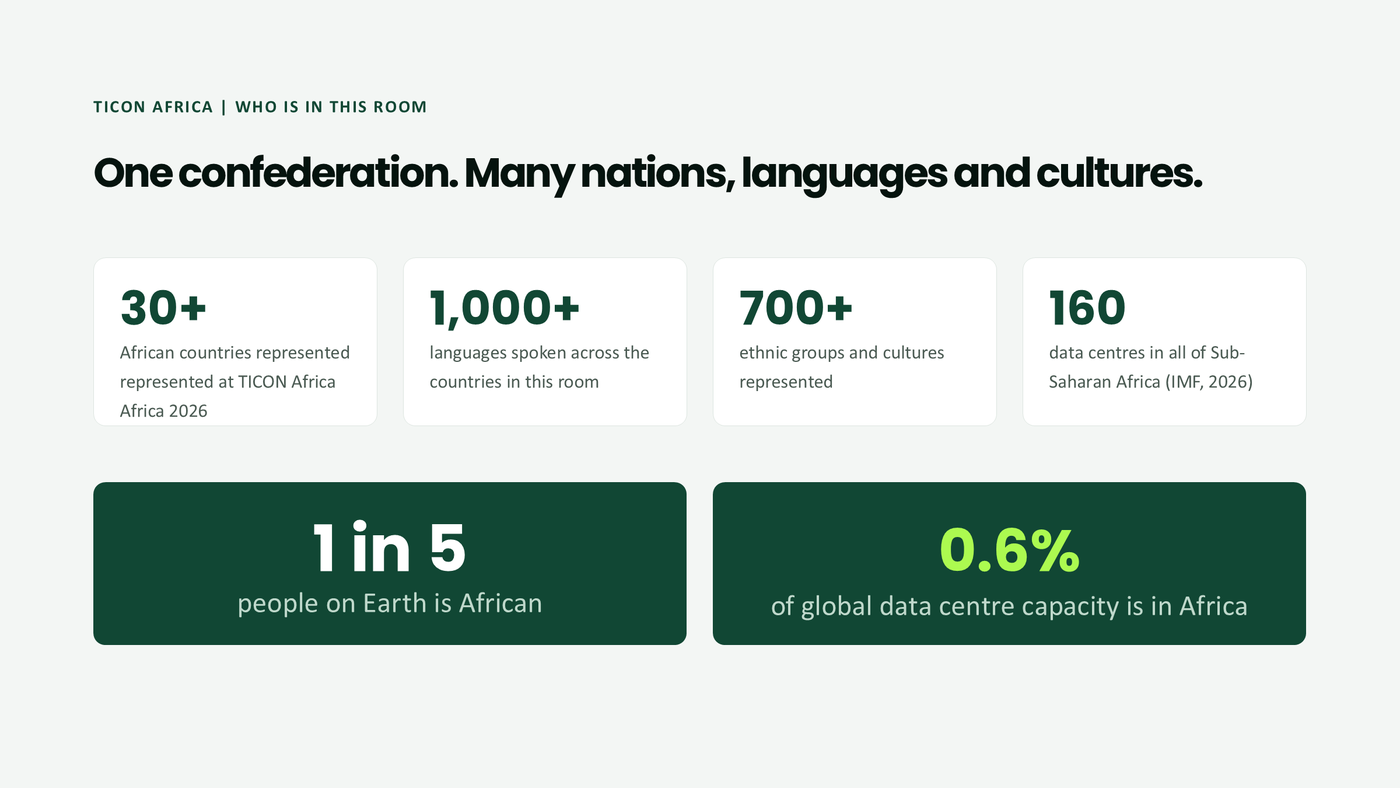
One confederation. Many nations, languages and cultures.
- 30+ African countries were represented at TICON Africa 2026.
- 1,000+ languages are spoken across the countries in that room.
- 700+ ethnic groups and cultures were represented.
- 1 in 5 people on Earth is African.
And yet:
- There are 160 data centres in all of Sub-Saharan Africa (IMF, 2026).
- Only 0.6% of global data centre capacity is in Africa.
The language and culture numbers are conservative lower bounds, and data centre counts vary depending on what you count. The point stands either way. Our diversity is our asset, but the infrastructure that AI runs on largely sits somewhere else.
The problem, as we see it
AI is being built without us, because our data was collected, stored and maintained without us, and mostly somewhere else. That shows up as:
- our data, stored and processed offshore;
- models that barely speak our 2,000+ languages;
- knowledge from elders and communities left out of datasets; and
- decisions about us, made far from us.
There is a second problem, and it lives in our heads. We tell ourselves we are behind the curve. We are playing catch-up. Some of us work alone, some together. So we hustle, and we are brilliant at it.
Hustling is a strength. But hustling alone is how we stay small. We are enabling ourselves as hustlers, but are we enabling each other? Are we being Ubuntu?
From data to wisdom, and where our strength sits
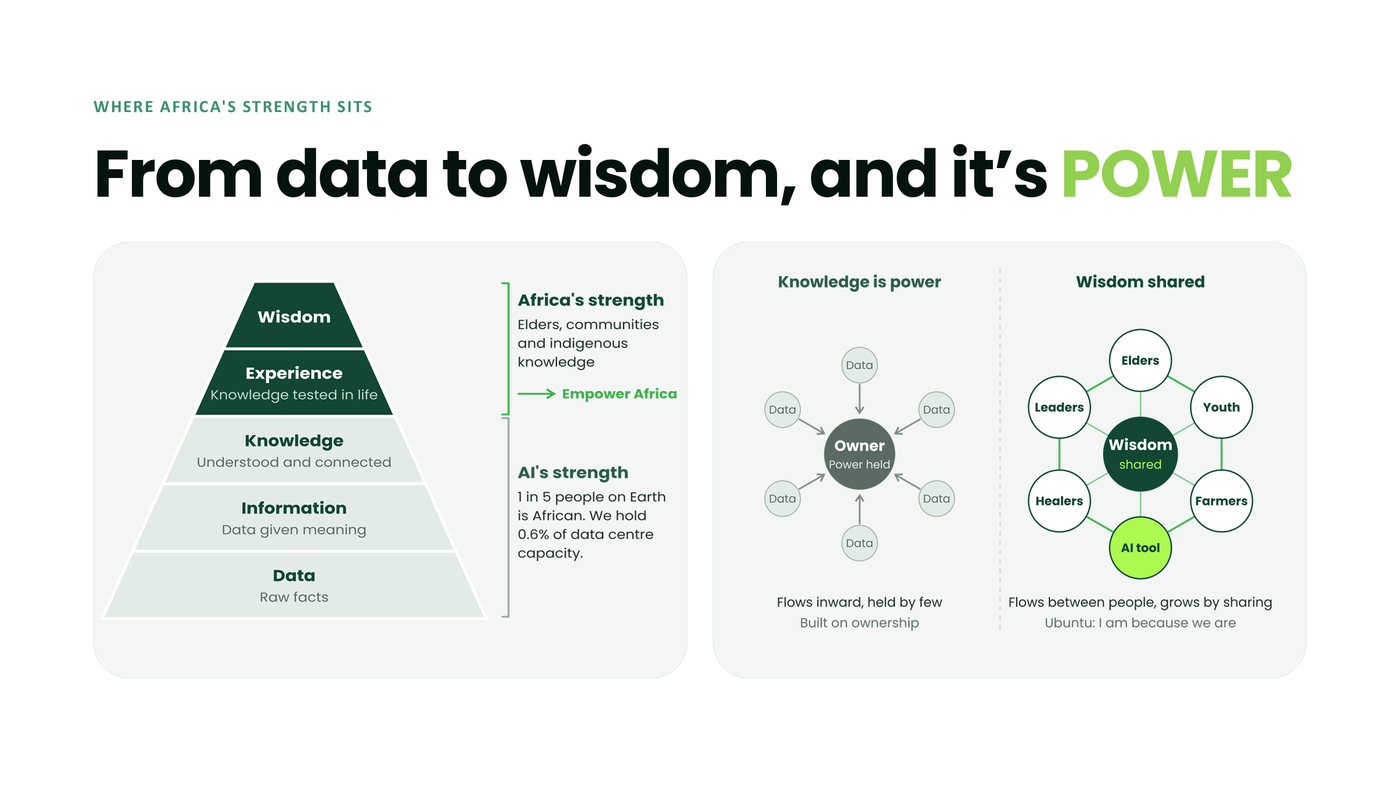
AI is strongest at the bottom of the pyramid. Africa is rich at the top.
The classic pyramid goes data, information, knowledge, experience and finally wisdom. AI is strongest at the bottom steps: raw facts, data given meaning, knowledge understood and connected. That is exactly where Africa's 0.6% share of data centre capacity hurts.
But wisdom needs experience, knowledge tested in life. That is where Africa is rich: elders, communities and indigenous knowledge.
The right-hand side of the slide compares two models. In the "knowledge is power" model, data flows inward and is held by an owner. In the Ubuntu model, wisdom is shared around a circle of elders, youth, leaders, healers and farmers, and AI is one participant serving the community rather than the centre controlling it. Machines can give us knowledge. Only people can give us wisdom.
The proof: Africa is already building
It would be easy to stop at the problem. But Africa is already building, and the track record is impressive.
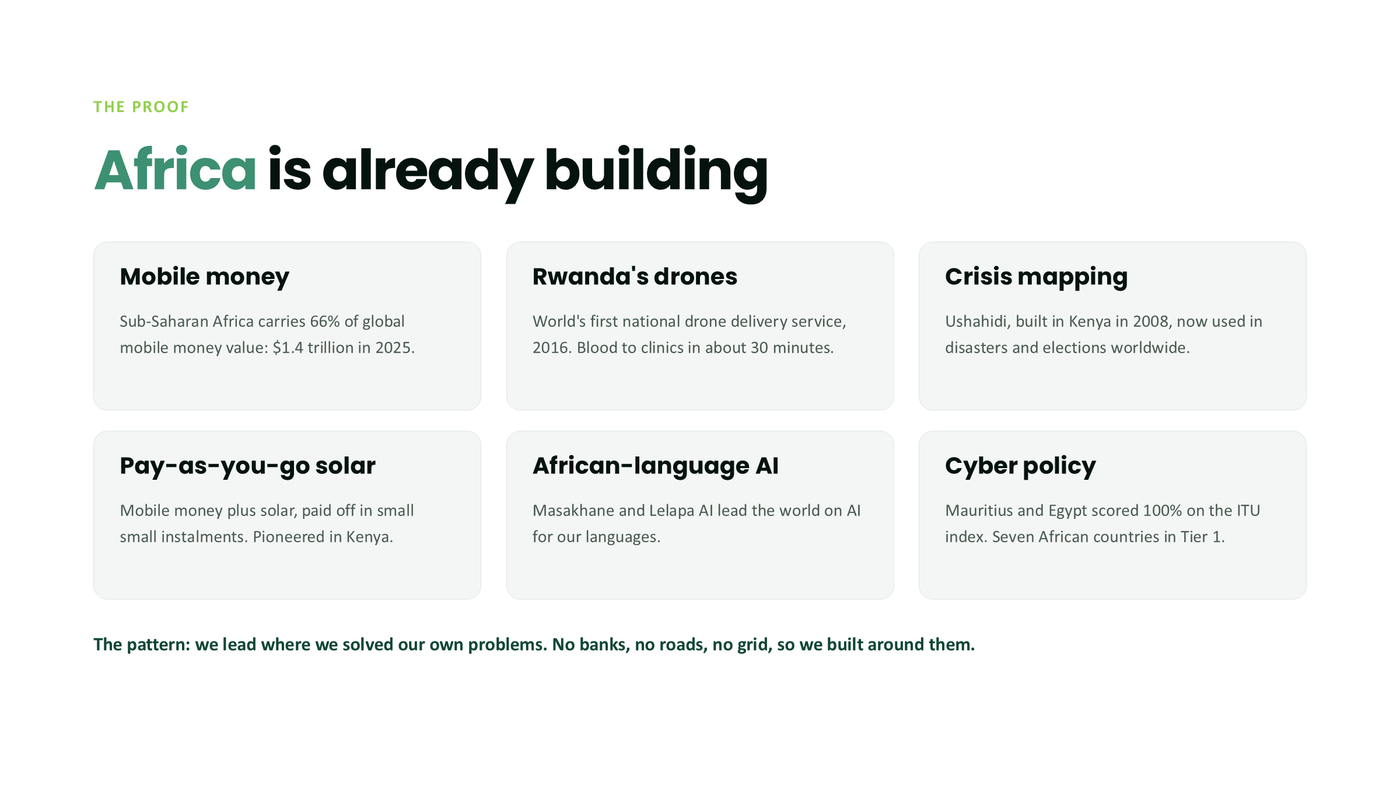
Africa is already building.
- Mobile money: Sub-Saharan Africa carries 66% of global mobile money value: $1.4 trillion in 2025. The global model for banking the unbanked was built here.
- Rwanda's drones: the world's first national drone delivery service, launched in 2016, gets blood to clinics in about 30 minutes. Zipline is a US company, but Rwanda had the vision and wrote the rules first.
- Crisis mapping: Ushahidi, built in Kenya in 2008, is now used in disasters and elections worldwide.
- Pay-as-you-go solar: mobile money plus solar, paid off in small instalments. Pioneered in Kenya.
- African-language AI: Masakhane and Lelapa AI lead the world on AI for our languages.
- Cyber policy: Mauritius and Egypt scored 100% on the ITU index, and seven African countries are in Tier 1.
The pattern is the important part: we lead where we solved our own problems. No banks, no roads, no grid, so we built around them. To be honest, we don't lead on compute or frontier models yet, and that honesty makes the rest of the list more convincing, not less.
Where the opportunities are
Looking towards a 2030 vision, the opportunities include 6G communication (enabling immersive experiences and remote surgery), quantum technologies (enhancing computing power and cybersecurity), advanced brain-computer interfaces (integrating human thought with technology) and interconnected cities (optimising urban living with AI and IoT). The question is whether Africa will be a builder of these technologies or only a market for them.
What "by Africa" requires
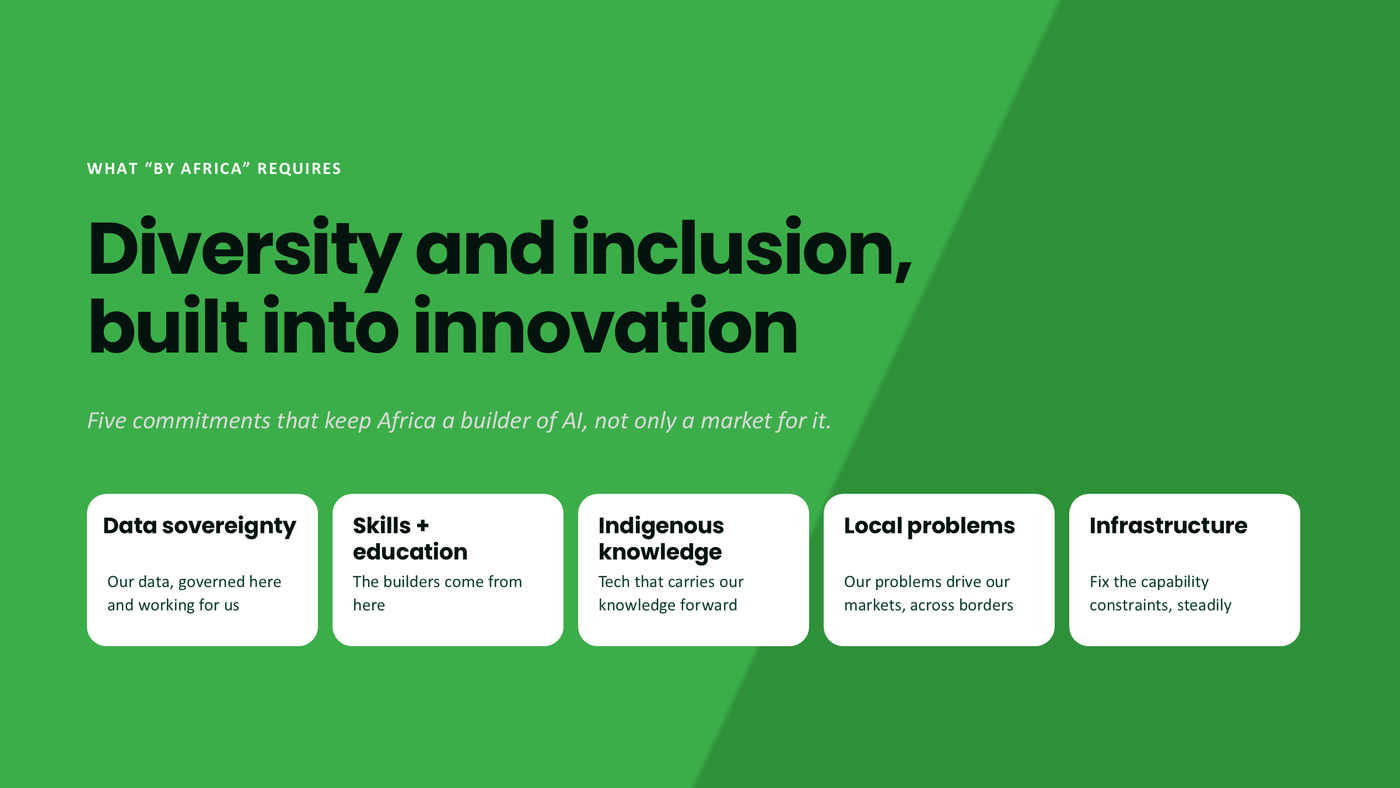
Five commitments that keep Africa a builder of AI, not only a market for it.
Diversity and inclusion have to be built into innovation, not bolted on. That takes five commitments:
- Data sovereignty: African data, governed here and working for Africans.
- Skills and education: the builders come from here, and this is where institutions like ours come in.
- Indigenous knowledge: adopt tech that records and carries our knowledge systems forward, in our languages.
- Local problems: let our problems drive our markets, and collaborate across borders rather than competing alone.
- Infrastructure: power and compute are real constraints. Fix them steadily, and be honest that it takes time.
Rise together, starting this week
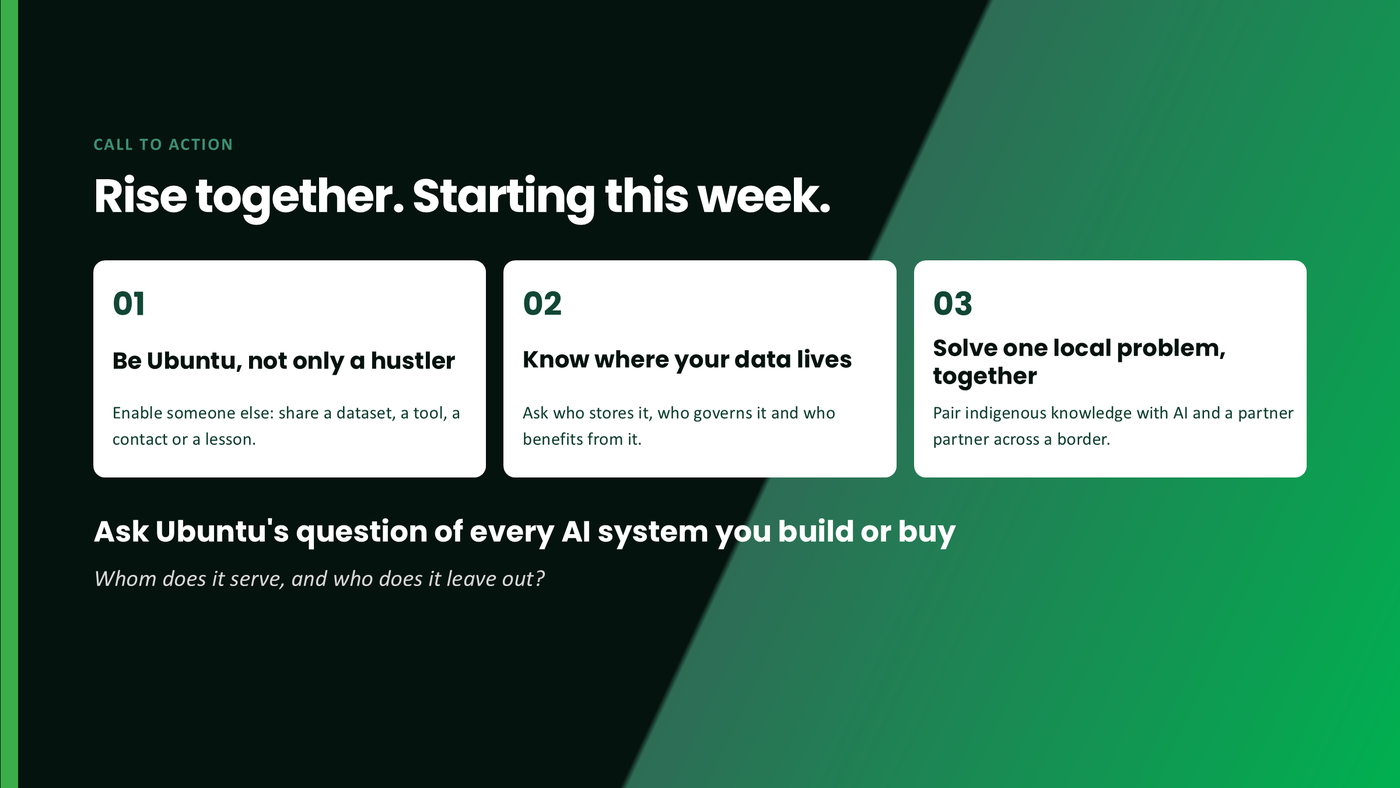
Small, concrete actions beat big, vague intentions.
Big visions are lovely, but I closed with three small, concrete actions:
- Be Ubuntu, not only a hustler. This week, enable one other person or organisation: share a dataset, a tool, a contact or a lesson.
- Know where your data lives. Ask who stores it, who governs it and who benefits from it.
- Solve one local problem, together. Pair indigenous knowledge with AI and a partner across a border.
And whenever you build or buy an AI system, ask Ubuntu's question of it: whom does it serve, and who does it leave out?
Questions to keep the conversation going
I left the room with three questions, and I'll leave them with you too:
- Which of our problems should African AI solve first?
- How do we share data without losing sovereignty?
- What will you do to enable someone else?
The question isn't whether AI will come to Africa. It's whether Africa's voice will be in it. I am because we are, so let's keep building, together. Zikomo. Twalumba. Thank you.