Emerging Trends Shaping AI, Intelligent Automation & the Future of Technology Leadership

Every year there's a new list of "top technology trends", and every year most of us skim it, nod and go back to our inboxes. When I put together a 90-minute working session on emerging trends in AI, automation and technology leadership, I wanted to do something a bit different: less "here are ten shiny things", more "here's how they fit together and what you, as a leader, should actually do about them".
I asked everyone to note one trend they thought was over-hyped and one they thought was under-hyped at the start, and to revisit those notes at the end. It's a good exercise to try while you read this.
Why now? Four forces driving convergence
No single trend matters in isolation. Four background forces push all of them forward at the same time:
- Compounding AI capability: each model generation unlocks deeper reasoning, longer autonomy and richer multimodality. The gains stack rather than plateau, so what software can do resets every year.
- Collapsing cost curves: compute, sensors, robotics hardware and connectivity keep getting cheaper per unit of capability, which moves frontier technology from the lab into everyday operations.
- A world being instrumented: billions of connected devices blur the boundary between physical and digital. Every process now produces data that intelligence can act on.
- Societal pull, regulatory push: ageing workforces, skills shortages and climate targets demand automation, while regulation such as the EU AI Act shapes how it lands.
Capability is the engine, cost collapse is the distributor, instrumentation supplies the fuel (data), and society and regulation set the guardrails.
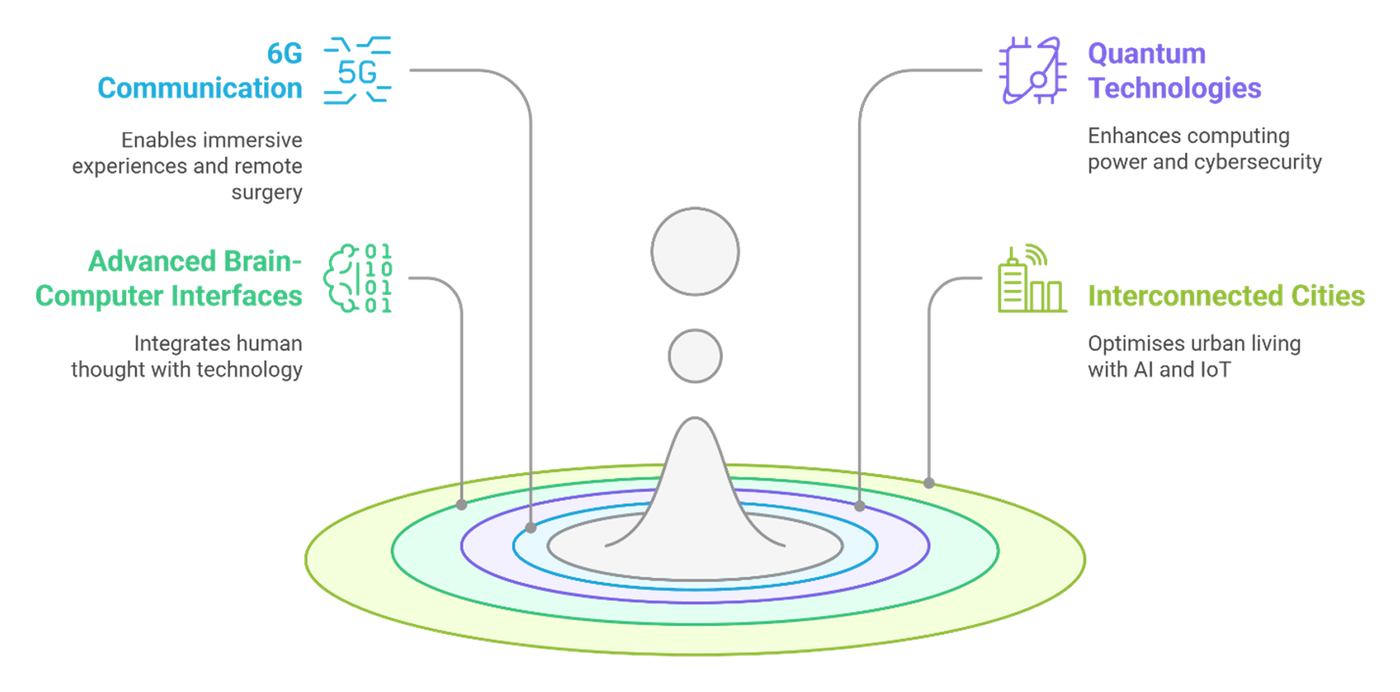
Each breakthrough ripples outward: 6G, brain–computer interfaces, quantum technologies and interconnected cities amplify one another.
How the trends interlock
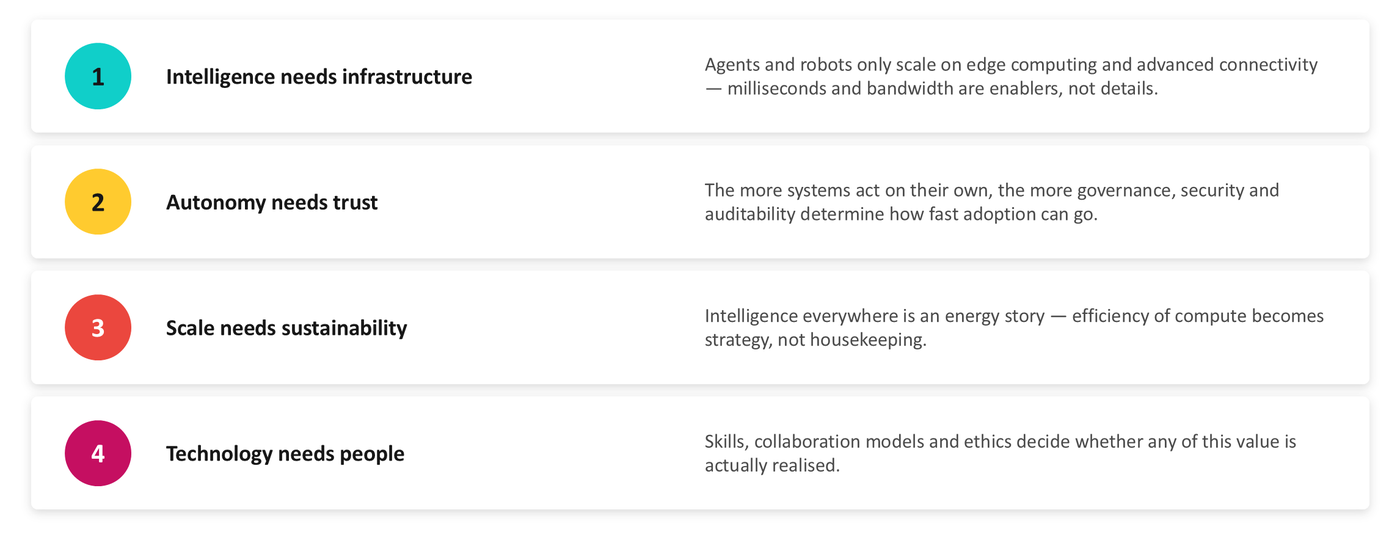
This is the thesis of the whole session: the trends form one system with dependencies.
- Intelligence needs infrastructure. Agents and robots only scale on edge computing and advanced connectivity. Milliseconds and bandwidth are enablers, not details.
- Autonomy needs trust. The more systems act on their own, the more governance, security and auditability decide how fast adoption can go.
- Scale needs sustainability. Intelligence everywhere is an energy story, so efficient compute becomes strategy, not housekeeping.
- Technology needs people. Skills, collaboration models and ethics decide whether any of the value is actually realised.
The rest of the session followed those dependencies: automation, then infrastructure, then trust.
Part one: intelligent automation, from tools that answer to systems that act
Agentic AI is the pivotal shift. These are AI systems that pursue goals through a loop: perceive the context, plan the steps, use tools and evaluate the results, with memory and the authority to act rather than only advise. A chatbot ends with an answer; an agent ends with a completed task. We're already seeing agents triage incidents and maintain code, own whole customer journeys (identity, diagnosis, action and follow-up), re-plan supply chains against live signals, and compress research and reporting from days to hours, with humans setting intent, reviewing output and handling exceptions.
Alongside agents sit three related trends:
- Polyfunctional robots: general-purpose machines that switch between picking, packing, inspecting and transporting, rather than being engineered for a single job. One flexible platform can replace several fixed automations.
- Ambient invisible intelligence: cheap sensors, low-power connectivity and on-device AI woven into spaces and objects, with no screens or prompts. Think real-time asset tracking, buildings that adjust to actual occupancy and patient monitoring beyond hospital walls.
- Human–AI collaboration: as generation becomes cheap, the bottleneck shifts to directing, evaluating and integrating AI output. Organisations that redesign roles around augmented professionals outperform those that just add a chatbot.
The leadership question I left on the table: Which decisions are you willing to delegate to an agent, and how will you audit them?
Part two: the infrastructure of intelligence
Everything in part one assumes the rails exist.
- Extended edge computing puts compute where data is created, so decisions happen in milliseconds without a round trip to the cloud. Latency, not capacity, becomes the design constraint.
- Advanced connectivity and 6G combines higher speeds, very low latency and integrated sensing. The network itself becomes a sensor. Standards are being defined now, so connectivity choices made in the next few years will shape a decade of capability.
- Quantum technologies promise a step change for optimisation, simulation and materials science, and a looming disruption to today's encryption.
- Interconnected cities are where it all meets in public: energy, mobility, water and safety orchestrated as one continuously learning system, often mirrored in digital twins.
Part three: trust is the rate-limiter
Capability decides what's possible; trust decides what gets adopted.
- Post-quantum cryptography: "harvest now, decrypt later" means adversaries can stockpile encrypted data today and unlock it later. Migrations like this take years, so the deadline is set by how long your data must stay secret, not by when quantum computers arrive. The real first project is a crypto inventory: finding out where your cryptography actually lives.
- AI governance: risk-tiered approvals, observability and audit trails for what agents actually did, clear human-in-the-loop thresholds and supplier due diligence. With agents, you're no longer reviewing outputs; you're supervising actions. Good governance is an accelerator, because clear rules let teams move fast without asking permission every time.
- Sustainable technology: AI compute demand is colliding with grid capacity. Efficiency per unit of intelligence is becoming a competitive metric, not a CSR footnote.
- Human-centred safeguards: as brain–computer interfaces move from clinical trials towards the workplace, privacy, consent and cognitive liberty become board-level issues.
The future of technology leadership
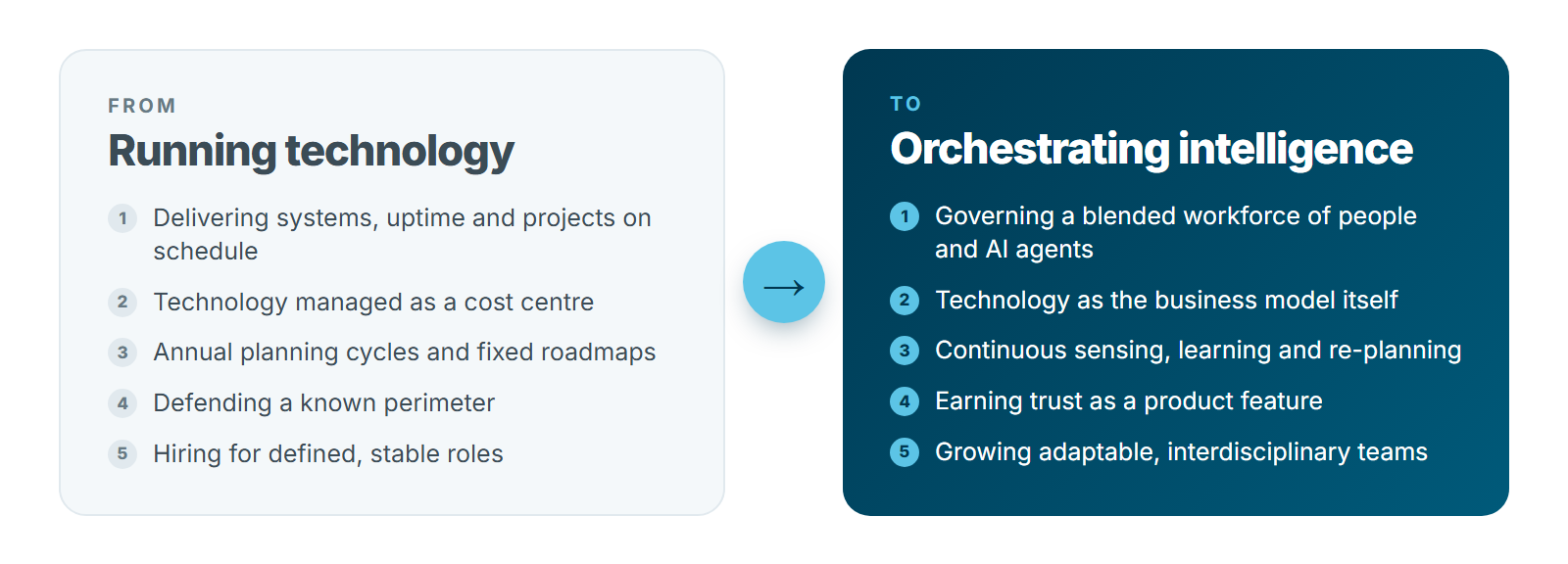
From running technology to orchestrating intelligence.
All of this changes the job. Technology leaders are moving from delivering systems on schedule, running a cost centre and defending a known perimeter to governing a blended workforce of people and AI agents, treating technology as the business model and earning trust as a product feature. Headcount planning will soon include agents, and someone has to own their performance and conduct.
Five imperatives came out of the session:
- Build an agentic operating model: redesign workflows around blended human–AI teams and decide where agents act autonomously.
- Invest in trust by design: governance, security and post-quantum readiness from day one. Trust is the licence to automate.
- Grow skills faster than knowledge: with knowledge on tap, the advantage shifts to adaptability and continuous learning. Baseline AI fluency across the whole organisation before building elite specialist teams.
- Modernise the foundation: edge, connectivity and quantum-ready infrastructure decide how fast intelligence can be deployed.
- Lead responsibly: the trends that endure are the ones people trust.
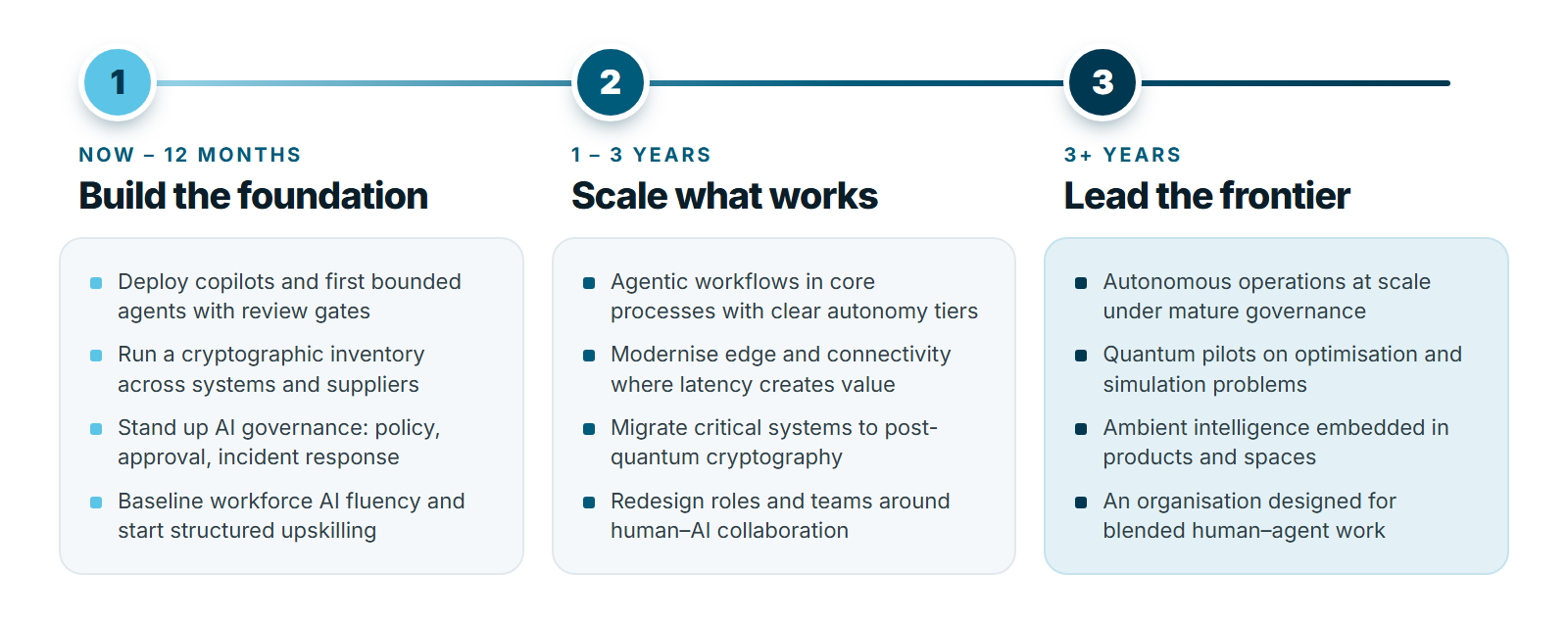
Build the foundation, scale what works, lead the frontier: a portfolio, not a queue.
To make it practical, we mapped it onto three horizons. Now to 12 months: deploy copilots and first bounded agents with review gates, run a cryptographic inventory, stand up AI governance and baseline workforce AI fluency. One to three years: scale agentic workflows with clear autonomy tiers, modernise edge and connectivity where latency creates value, and redesign roles around human–AI collaboration. Three years and beyond: autonomous operations under mature governance, quantum pilots and an organisation designed for blended human–agent work. The horizons overlap, but horizons two and three fail without horizon one.
Watch out for…
- Autonomy without oversight: agents acting at machine speed can compound errors at machine speed. Contain and observe before you scale.
- Security debt meets a deadline: postponement is a decision, and it comes with interest.
- Workforce whiplash: capability is shifting faster than skills, and that gap turns into attrition and quiet adoption failure.
- Hype-cycle misallocation: over-investing in demos while under-investing in data quality, integration and change management, the unglamorous work that decides outcomes.
In conclusion
Everyone gets access to the same technology. The advantage comes from how you organise, govern and grow your people around it. The trends are given; the organisational response is a choice you make this year. So, back to your notes: has your over-hyped trend changed?