The Future of RPA is Agentic: Robotic and Agentic Process Automation
Every few months someone asks me whether RPA is dead now that AI agents have arrived. My answer is always the same: no, it just got a very clever new colleague. Over the past year I've given versions of this talk in a few different rooms: the Belgium Campus Agentic AI Masterclass (9 April 2025), Stellenbosch Business School (as "Process Automation: The Agentic Age"), the FMHL ICT Conference and a series of sessions with TVET colleges. The audiences were very different, but the questions kept coming back to the same few ideas. This post pulls the best of those sessions together.
The short version? The future is both robotic and agentic.
Left brain, right brain
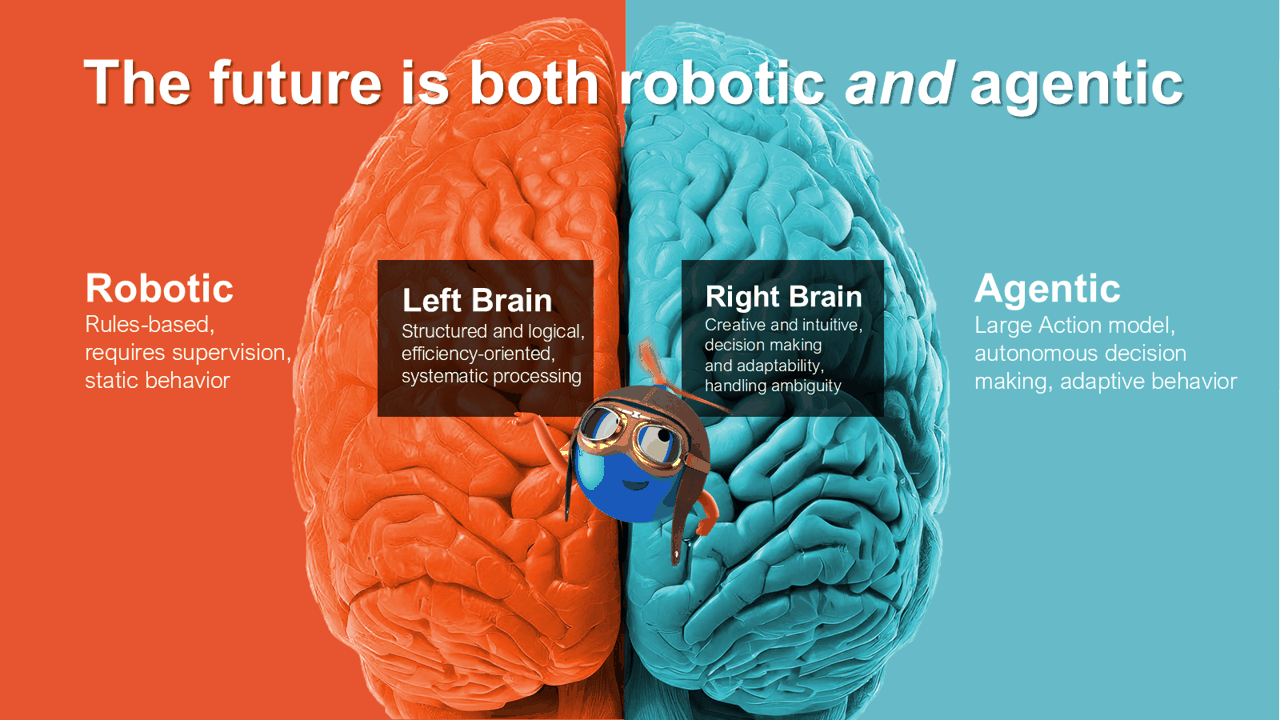
Robots are the left brain, agents are the right brain, and you need both.
The easiest way I've found to explain this is to think of the two halves of a brain.
- Robotic automation is the left brain. It's structured, logical, efficiency-oriented and systematic. It follows rules, it needs supervision and its behaviour is static: it does exactly what you built it to do, every single time.
- Agentic automation is the right brain. It's more creative and intuitive. It makes decisions, adapts and handles ambiguity. Under the hood that's large action models, autonomous decision-making and adaptive behaviour.
Daniel Dines (UiPath) uses a lovely example to explain the difference. When you wake up at night at home and want a glass of water, you barely think about it. You know where the fridge is, how to open it and where the bottle lives. You probably won't even remember doing it the next morning. That's RPA: predefined building blocks stitched together, efficient and low-effort, as long as the environment is familiar and predictable.
Now wake up thirsty in a hotel room. Same goal, different layout. You still use your basic routines (walking, opening a fridge), but you have to think about how to apply them. That's agentic automation: AI that breaks a goal into smaller building blocks, orchestrates them on the fly and deals with the exceptions and unfamiliar situations that would stop a traditional bot in its tracks.
Agents don't replace the routines; they decide how to use them. That's why the conversation shouldn't be "RPA or agents", but "RPA and agents".
Three types of process automation
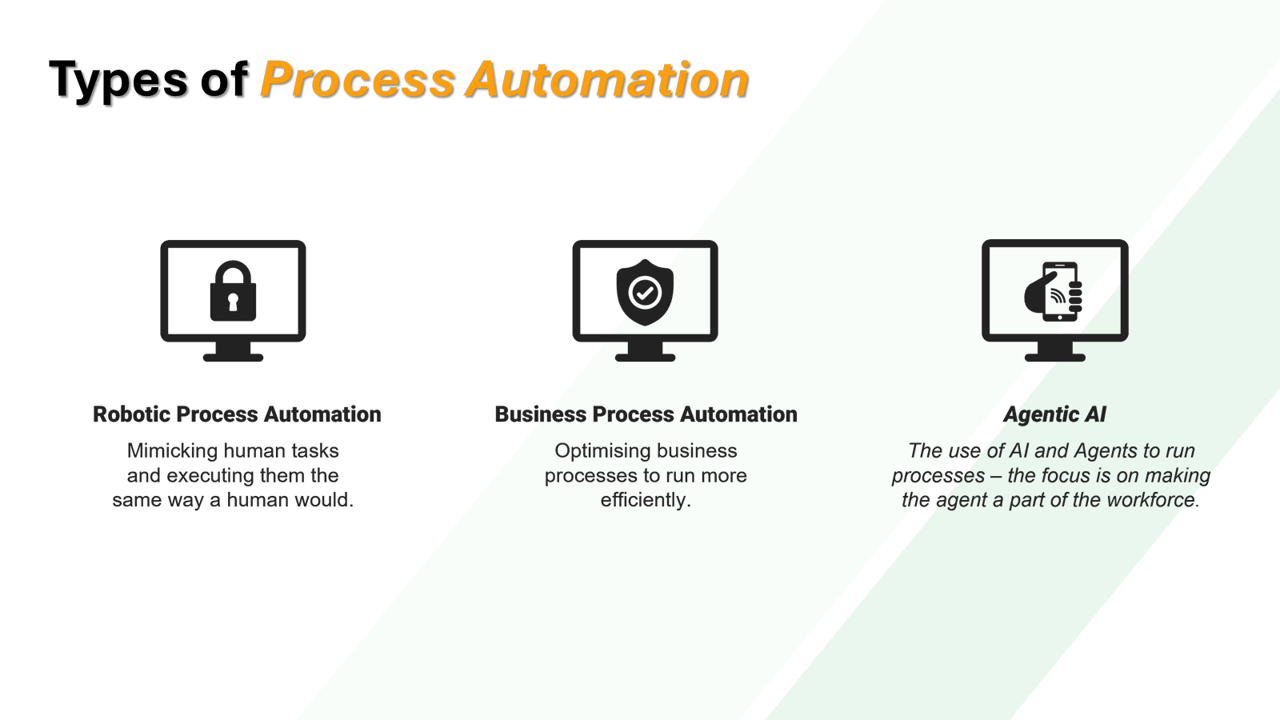
When people say "automation", they usually mean one of three things:
- Robotic Process Automation (RPA): mimicking human tasks and executing them the same way a human would (clicking, typing, copying and pasting across applications).
- Business Process Automation (BPA): optimising the business process itself so it runs more efficiently, often by redesigning the workflow rather than just speeding up the clicks.
- Agentic AI: using AI and agents to run processes, where the focus is on making the agent part of the workforce.
At its core, process automation is the use of technology to enhance efficiency, automate repeatable tasks, reduce manual effort (and the errors that come with it) and streamline operations so work flows better. The benefits I see most often are time savings, error reduction, increased productivity, cost efficiency, faster decision-making and improved compliance. All of that adds up to a more efficient organisation.
When you build a business case, it also helps to be honest about what kind of saving you're claiming. I split it into three buckets:
- Cost transference: substituting one cost for another, or moving who's accountable for the cost.
- Cost reduction: reducing the direct and/or indirect cost of executing a process.
- Cost mitigation: avoiding additional costs that don't fit into the other two.
FTE hours and capacity availed are the easy wins to measure, but don't forget the secondary ones: frequency and efficiency improvements, customer and employee satisfaction, and the financial impact of all of those.
How we got here
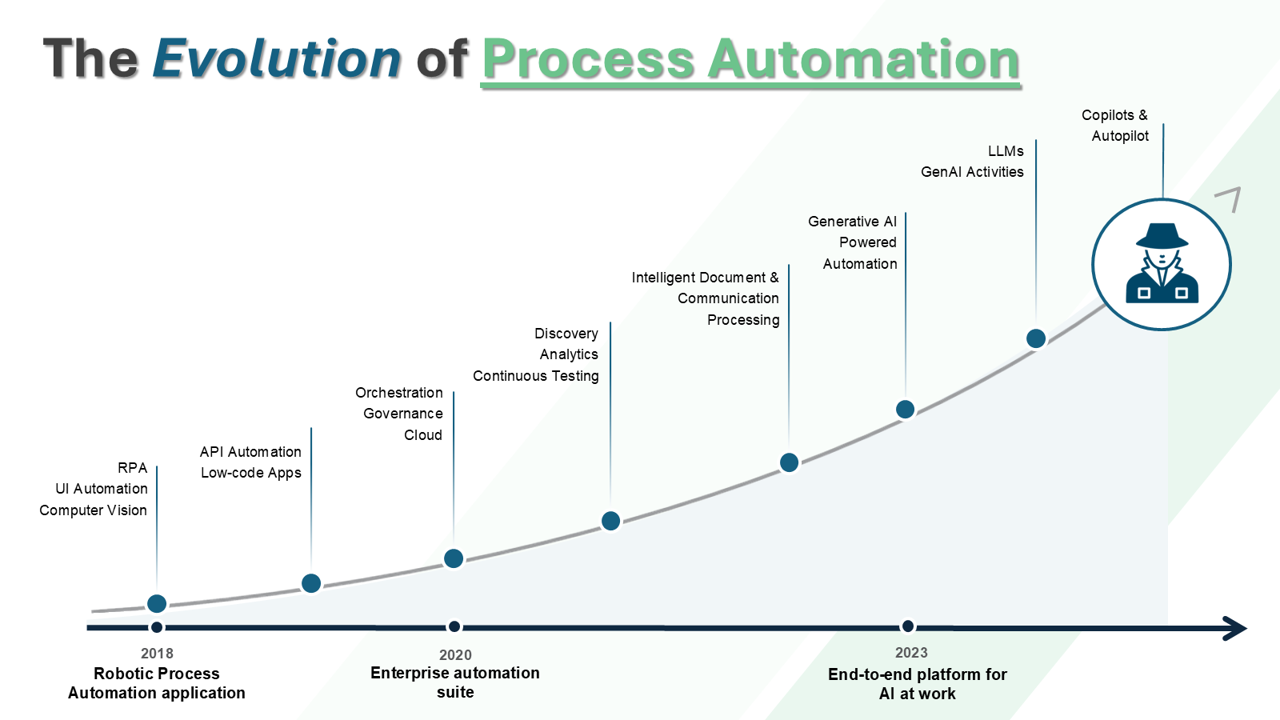
From RPA application (2018) to enterprise automation suite (2020) to an end-to-end platform for AI at work (2023).
None of this appeared overnight. Around 2018, RPA was mainly UI automation and computer vision. Then came API automation, low-code apps, orchestration, governance and cloud. By 2020 we were talking about enterprise automation suites with discovery, analytics and continuous testing built in. After that came intelligent document and communication processing, generative AI-powered automation, LLMs and GenAI activities, and now copilots and autopilots.
Each layer builds on the one before it. The agents of today still lean on the robots, connectors and governance we've been building for years.
Designing an agentic workforce
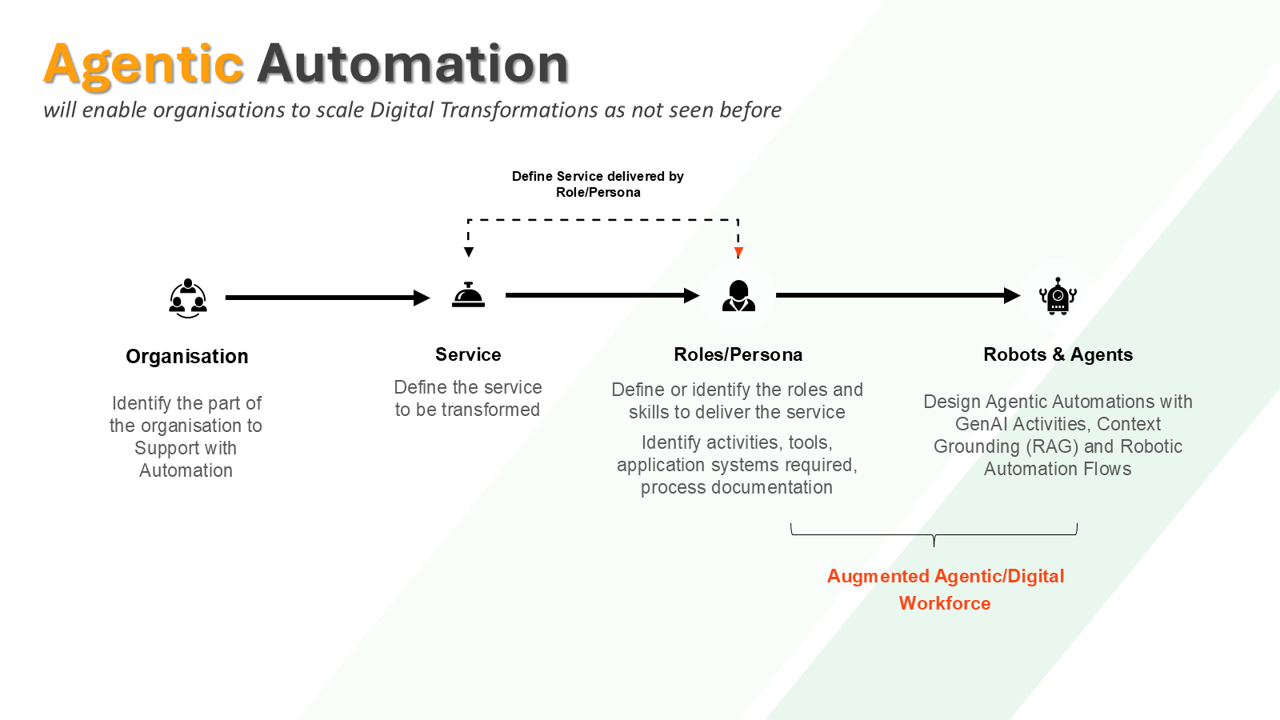
Organisation → Service → Roles/Persona → Robots & Agents = an augmented agentic/digital workforce.
Agentic automation will help organisations scale digital transformation in a way we haven't seen before, but only if it's designed deliberately. The framework I use starts with the business, not the technology:
- Organisation: identify the part of the organisation you want to support with automation.
- Service: define the service that needs to be transformed.
- Roles/Persona: define the roles and skills needed to deliver that service, along with the activities, tools, application systems and process documentation involved.
- Robots & Agents: design agentic automations using GenAI activities, context grounding (RAG) and robotic automation flows.
The outcome is an augmented agentic/digital workforce: services delivered by a mix of people, robots and agents, each doing the part they're best at.
Picking the right processes
This is where most programmes win or lose. A shiny agent on top of a broken process is still a broken process, just faster.
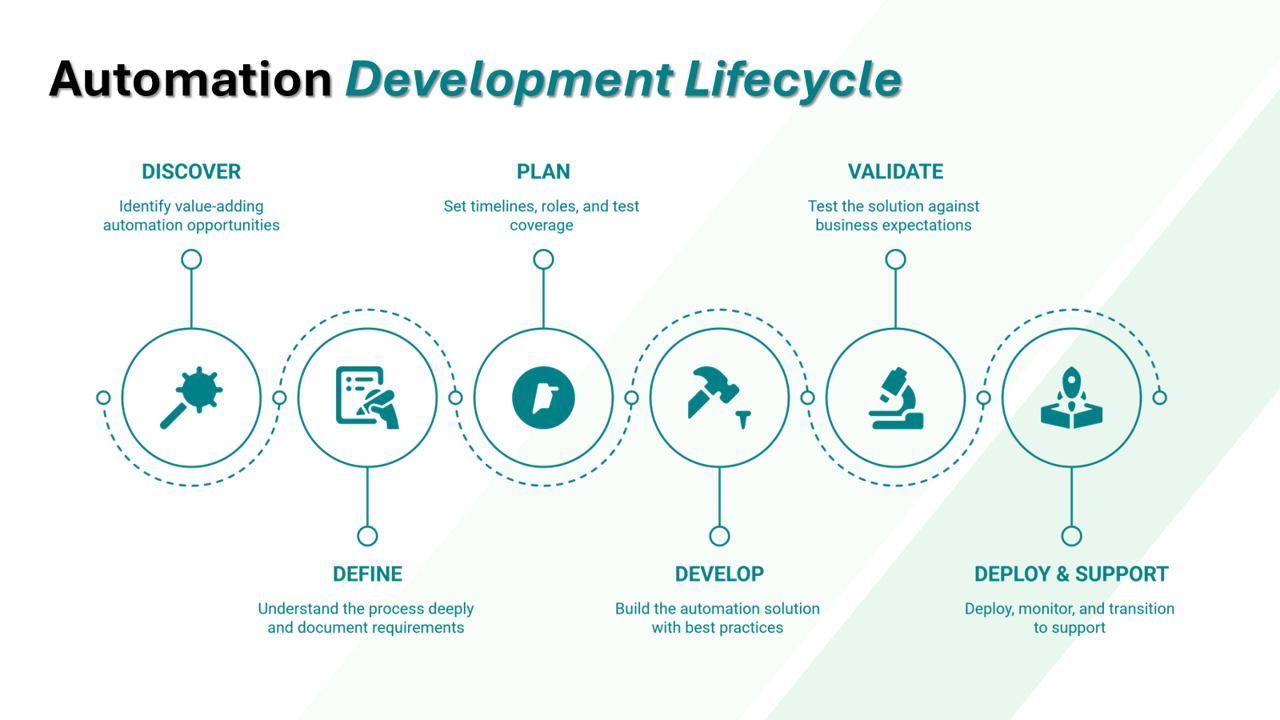
The automation development lifecycle starts with Discover (identify value-adding opportunities) and Define (understand the process deeply and document the requirements) long before anyone opens Studio. In the TVET sessions we spent a good chunk of time on process analysis, and the basics hold up:
- Start with the problem. Is there an inefficient process or a business problem to improve? Broken customer promises, a lack of standards or big variation between the people doing the work are all good signals.
- Map it. Define the flow unit, list the activities, put them in sequence with a precise start and stop, and use standard symbols. Flowcharts, swimlanes, SIPOC and value stream maps all have their place.
- Understand the variability. Volume swings, rework, missing SOPs and staff availability all affect how a process behaves. Rules-based, stable steps are robot territory. The messy, judgement-heavy bits are where agents start earning their keep.
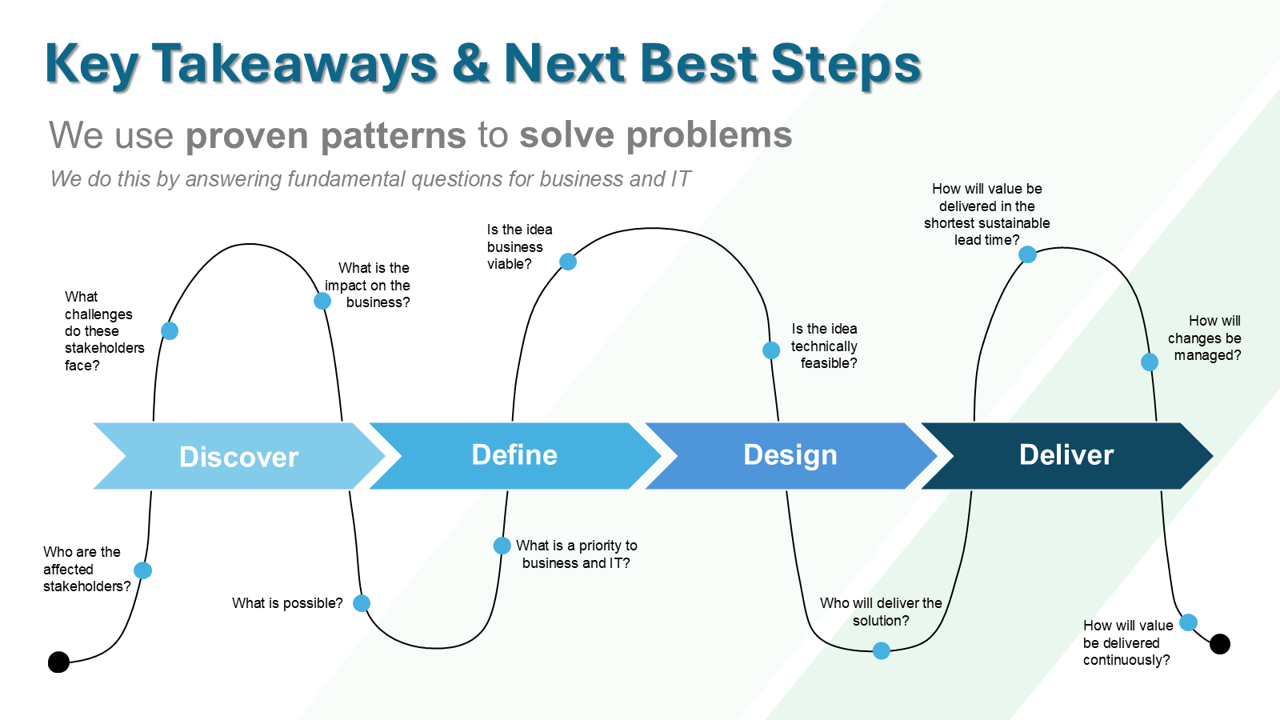
Proven patterns, driven by fundamental questions for business and IT.
Before committing, ask the questions business and IT both care about: What's the impact on the business? Who are the affected stakeholders, and what challenges do they face? Is the idea business-viable and technically feasible? Who will deliver it, how will changes be managed, and how will value be delivered continuously?
Why it's urgent and why it's hard
Demand isn't the problem. The 2024 Work Trend Index from Microsoft and LinkedIn found that 75% of knowledge workers already use AI at work ("employees want AI at work, and they won't wait for companies to catch up"). McKinsey's 2024 Global Survey on AI reported that 65% of organisations were using at least one GenAI capability in a business process.
Scaling is the hard part. In the same McKinsey survey, 70% of generative AI high performers said data was a challenge in capturing value. The blockers I see sit mostly below the waterline: technical (data quality, integration), ethical (privacy, accountability, transparency), organisational (resistance to change, resource allocation) and strategic (misalignment with business goals and keeping up with rapid change).
Governance matters even more with agents. Decide upfront what's autonomous and what needs a human in the loop, and treat AI as an augmenter rather than a replacer.
In conclusion
RPA isn't going anywhere. It's the reliable left brain your agents will lean on. The organisations that get the most out of this next wave will be the ones that combine both halves on purpose: robots for the predictable, agents for the ambiguous and people for the judgement calls. Pick your processes carefully, sort out your data and design the workforce before you build the bots.