Mapping a Career in AI and Automation: The Landscape, the Roles and the Skills
"Where do I even start?" is the question I get asked most about AI and automation. It's a fair question. The field moves quickly, the job titles blur into each other, and every week there's a new tool that promises to change everything.
The good news: you don't need to know everything to get started. You need a map. In this post I walk through four of them: the landscape, the roles, the skills and the steps to your first job.
You don't need a computer science degree
Before the maps, something worth celebrating: we're living in the age of citizen development. Low-code tools have made building solutions far more accessible. They empower people who would never call themselves "developers", they improve efficiency, and they open the door to innovation. Plenty of excellent automation developers started out as analysts, administrators or accountants who were tired of doing the same task by hand every week.
Map 1: The landscape
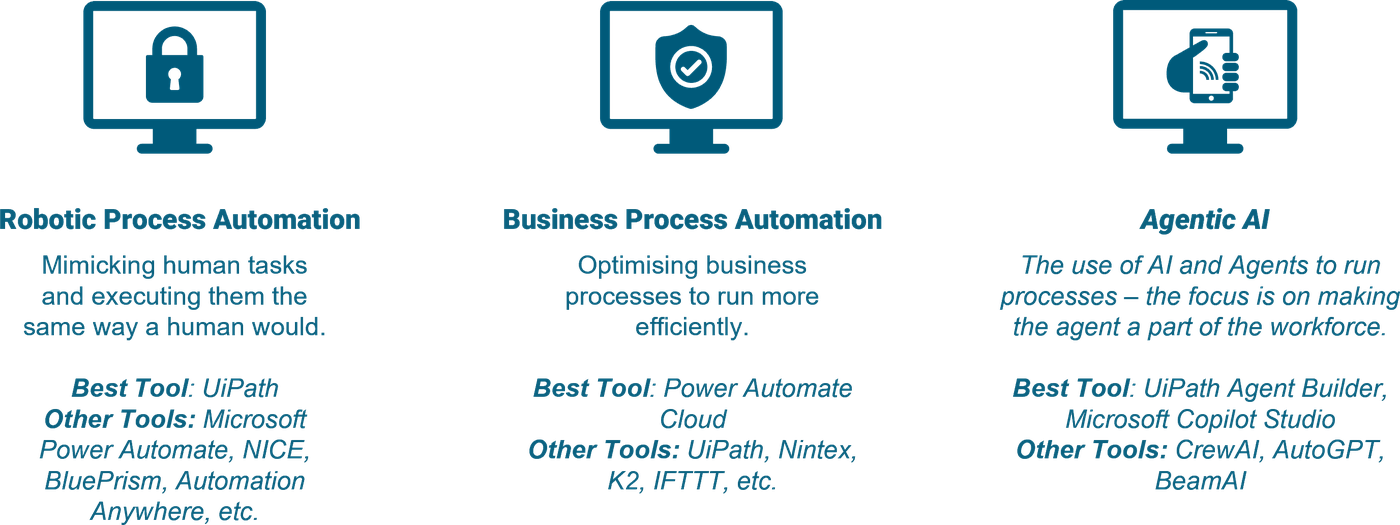
There are three broad areas worth understanding before you pick a direction.
Robotic Process Automation (RPA) mimics human tasks and executes them the same way a human would: clicking, typing, reading screens. My pick for the best tool here is UiPath, with Microsoft Power Automate, NICE, Blue Prism and Automation Anywhere as other options.
Business Process Automation (BPA) is about optimising business processes so that they run more efficiently, usually by connecting systems through APIs and workflows rather than through a screen. Here my pick is Power Automate Cloud, with UiPath, Nintex, K2 and IFTTT as alternatives.
Agentic AI uses AI and agents to run processes, and the focus shifts to making the agent part of the workforce. Instead of following a fixed script, an agent can reason about the next step. UiPath Agent Builder and Microsoft Copilot Studio lead the pack, with CrewAI, AutoGPT and BeamAI as other tools to explore.
You don't have to choose one forever. Most real solutions combine all three: an agent decides, a workflow connects the systems, and a robot handles the one legacy application without an API.
Map 2: The roles
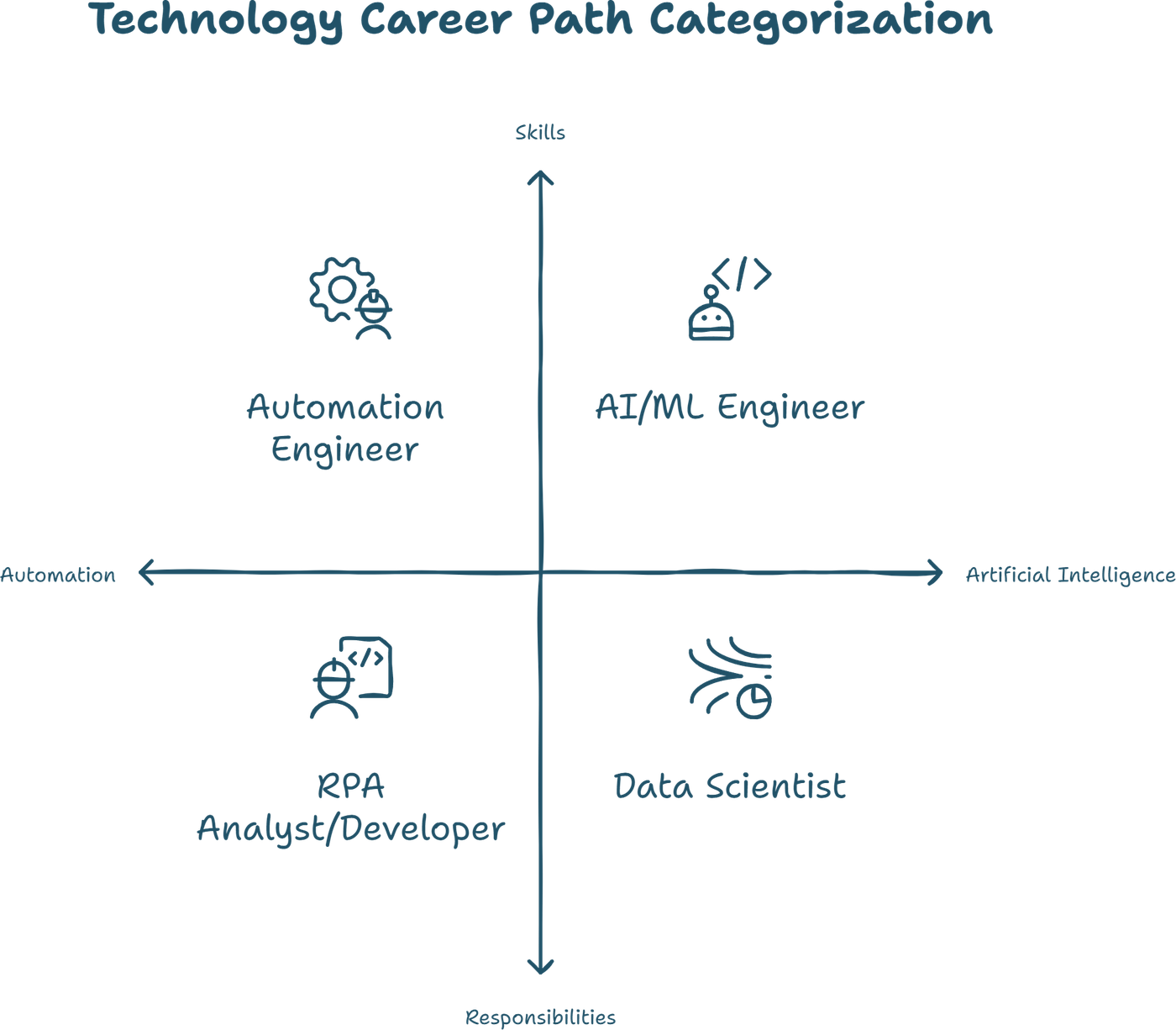
The job titles make more sense once you put them on two axes. Left to right runs automation to artificial intelligence. Top to bottom runs skills to responsibilities.
- RPA Analyst/Developer: automation-focused and responsibility-heavy. You analyse processes, design solutions and build the bots.
- Automation Engineer: still automation-focused, but deeper on the technical skills: architecture, integration and making things run reliably at scale.
- Data Scientist: on the AI side, analysing and interpreting complex data to inform decisions.
- AI/ML Engineer: AI-focused and skills-heavy, developing the models and systems that solve complex problems.
Underneath all of them sit two foundations: technical skills and business skills. And none of these quadrants is a life sentence. Plenty of people start as RPA developers and drift towards AI as their interests change, and the experience carries over.
Map 3: The skills
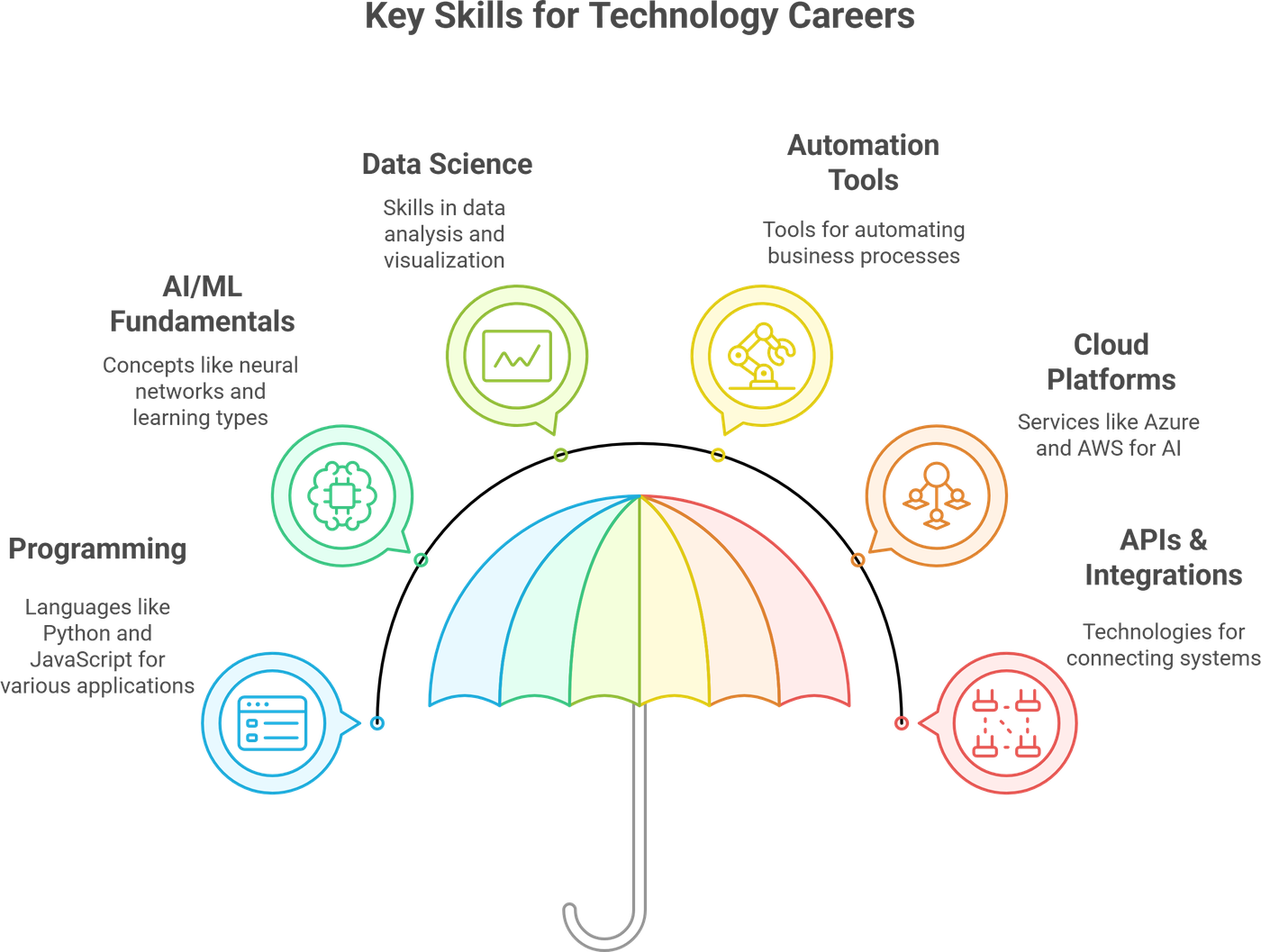
Think of your technical skills as an umbrella. The wider it is, the more you're covered:
- Programming: languages like Python and JavaScript, for all sorts of applications
- AI/ML fundamentals: concepts like neural networks and the different types of learning
- Data science: analysing and visualising data
- Automation tools: the platforms that automate business processes
- Cloud platforms: services like Azure and AWS for AI
- APIs and integrations: the technologies that connect systems together
But the umbrella only keeps you dry if someone lets you hold it. That's where the other skills come in:
- Problem-solving: spotting the repetitive tasks worth automating
- Critical thinking: evaluating AI solutions for efficiency and bias
- Business acumen: understanding where AI fits into the company's strategy
- Communication: explaining technical concepts to people who aren't technical
That last one is underrated. The best automation in the world is useless if you can't explain to the business why they should trust it.
Learning on four fronts
Learning works best as a double helix rather than a single road. Four strands twist together: formal education, certifications, self-learning and practical experience. You don't need to finish one before starting the next; they reinforce each other best when they happen at the same time.
To make the self-learning strand easier, I keep a list of valuable (and free!) learning resources for soft, business and technical skills on GitHub: Automation-AI-Learning-Resources.
Map 4: The steps to your first job
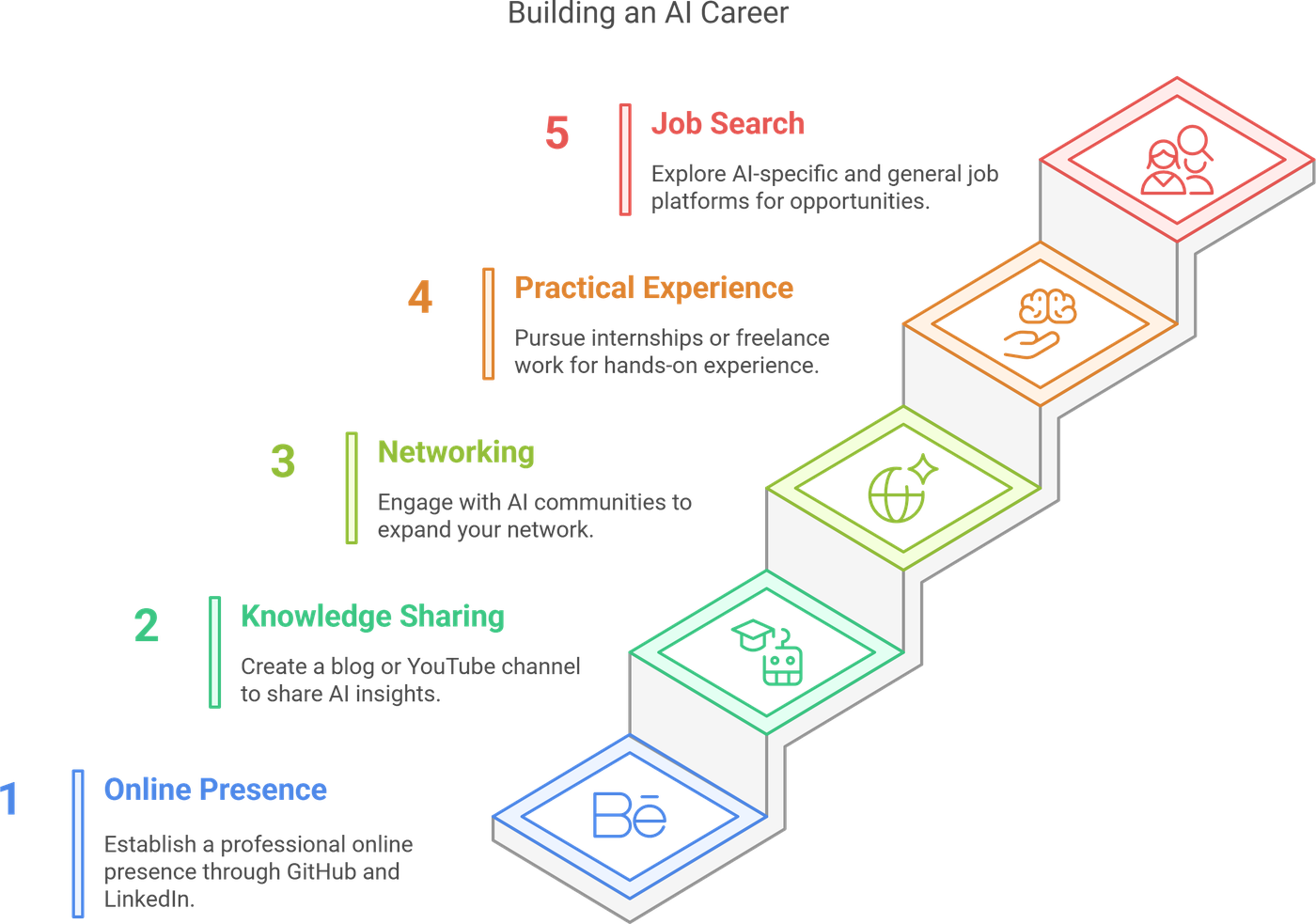
Building a portfolio is a staircase, and each step makes the next one easier:
- Online presence: establish a professional presence through GitHub and LinkedIn.
- Knowledge sharing: start a blog or YouTube channel and share what you're learning about AI.
- Networking: engage with AI and automation communities to grow your network.
- Practical experience: pursue internships or freelance work for hands-on experience.
- Job search: explore AI-specific and general job platforms for opportunities.
Notice that the job search is the last step, not the first. By the time you get there, people should already be able to find your work, read what you think and see what you've built.
Don't climb alone
Communities are where you learn what's actually happening in industry, find mentors and hear about opportunities before they're advertised. Look for UiPath Community chapter events, Power Platform user groups, AI and data meetups, and the big regional expos and conferences near you. Show up, ask questions, and then (my favourite part) start contributing.
In summary
A career in AI and automation isn't one path. It's a map you get to draw for yourself:
- Understand the landscape: RPA, BPA and agentic AI, and the tools for each.
- Pick a starting quadrant: analyst, engineer, data scientist or AI/ML engineer, knowing you can move.
- Widen your umbrella: technical skills, plus the problem-solving and communication that make them count.
- Climb the staircase: make your work visible before you start the job search.
- Find your people: communities turn learning into opportunities.
Start with whichever step feels smallest. Then take the next one.